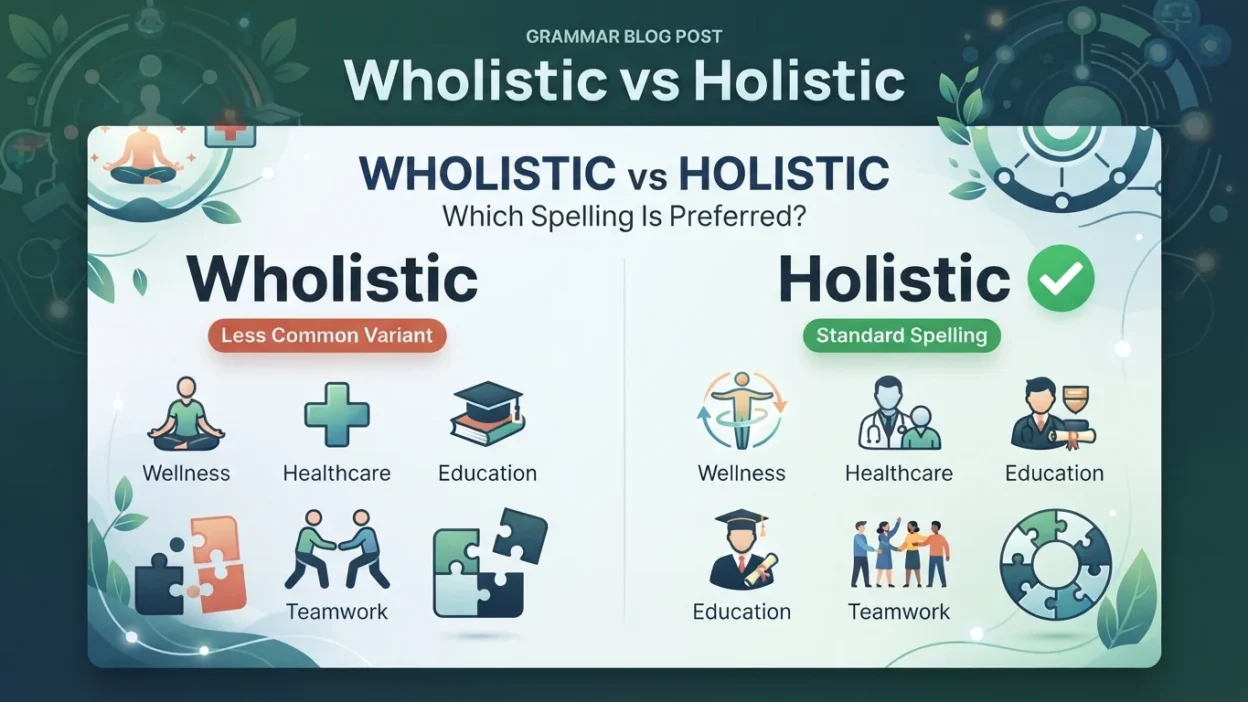
If you’ve ever wondered if “wholistic” or “holistic” is the correct spelling, you’re not alone. Both words appear in books, websites, and conversations, which can make the choice confusing. However, holistic is the standard and overwhelmingly preferred spelling in modern English.
While wholistic is recognized as a variant spelling by some dictionaries, it is much less common. In professional, academic, medical, and business writing, holistic is the recommended choice.
Quick Answer
“Holistic” is the standard and preferred spelling.
“Wholistic” is a less common variant that is occasionally used but generally not recommended for formal writing.
Correct Example
- The doctor takes a holistic approach to patient care.
Less Common Variant
- The clinic promotes a wholistic approach to wellness.
What Does Holistic Mean?
Holistic is an adjective that means:
- considering the whole rather than just individual parts
- treating a person, system, or problem as a complete unit
- focusing on physical, mental, emotional, social, and sometimes spiritual well-being together
It is commonly used in healthcare, education, psychology, business, and personal development.
Examples of Holistic in Sentences
- The school uses a holistic approach to education.
- She prefers holistic wellness practices.
- Our company developed a holistic marketing strategy.
- The therapist focuses on holistic healing.
- Effective leadership requires a holistic view of the organization.
Is Wholistic a Real Word?
Yes. Wholistic is a real word and is recognized by some dictionaries as a variant spelling of holistic.
However:
- Holistic is far more common.
- Wholistic is rarely used in professional or academic writing.
For most writers, holistic is the better choice.
Why Is “Holistic” Preferred?
The word holistic comes from the concept of holism, which emphasizes understanding something as a whole rather than as separate parts.
Although wholistic visually connects with the word whole, modern English overwhelmingly favors holistic.
Wholistic vs Holistic Comparison Table
| Feature | Holistic | Wholistic |
|---|---|---|
| Standard spelling | Yes | Variant |
| Most common usage | Yes | No |
| Dictionary recognized | Yes | Yes (variant) |
| Academic writing | Recommended | Rarely used |
| Professional writing | Recommended | Usually avoided |
Word Comparison
Common Mistakes With Holistic
Assuming “Wholistic” Is More Correct
Some people believe wholistic is better because it resembles whole, but holistic is the established standard spelling.
Mixing the Spellings
Choose one spelling consistently. In most cases, use holistic.
Using Wholistic in Formal Writing
Unless an organization or brand specifically spells it wholistic, use holistic in professional documents.
Different Uses of Holistic
Healthcare
Example:
- The clinic provides holistic treatment.
Education
Example:
- Teachers use holistic assessments.
Business
Example:
- A holistic strategy improves long-term success.
Personal Development
Example:
- She believes in holistic well-being.
Common Phrases Using Holistic
Holistic Approach
Meaning: considering every aspect of a situation.
Example:
- We need a holistic approach to solving the problem.
Holistic Health
Meaning: health that includes physical, mental, and emotional well-being.
Example:
- Holistic health focuses on the whole person.
Holistic Care
Meaning: comprehensive care for all aspects of a person’s well-being.
Example:
- Nurses provide holistic care to patients.
Holistic Development
Meaning: balanced growth in multiple areas.
Example:
- The program encourages holistic development in children.
Synonyms for Holistic
Depending on context, similar words include:
- comprehensive
- integrated
- all-inclusive
- complete
- whole-person
Example
- The organization adopted a comprehensive approach to employee well-being.
Opposites of Holistic
Antonyms may include:
- partial
- fragmented
- isolated
- narrow
- reductionist
Example
- Looking at only one factor provides a narrow view of the issue.
American vs British English Differences
Both American and British English strongly prefer:
- holistic
Wholistic is recognized in both varieties but remains uncommon.
Why Correct Spelling Matters
Using the preferred spelling improves:
- professionalism
- readability
- credibility
- academic accuracy
- communication clarity
Although wholistic is not technically wrong, using holistic aligns with standard English and reader expectations.
Tips to Remember the Correct Spelling
Think of “Holism”
The adjective comes from the noun:
- holism → holistic
Use the Standard Form
In nearly all situations, choose:
- holistic
Practice Full Sentences
Example:
- Our team developed a holistic business strategy.
FAQs About Wholistic vs Holistic
Which spelling is correct: wholistic or holistic?
Both exist, but holistic is the standard and preferred spelling.
Is wholistic a real word?
Yes. It is a recognized variant spelling, but it is much less common.
Why is holistic more common?
Because it comes from the noun holism and has become the accepted standard in modern English.
Should I use wholistic in professional writing?
Generally, no. Holistic is the recommended choice unless you’re referring to a brand or organization that intentionally uses wholistic.
Is holistic used in British and American English?
Yes. Both varieties overwhelmingly prefer holistic.
What does holistic mean?
It means considering the whole person, system, or situation rather than focusing only on individual parts.
Are holistic and wholistic different in meaning?
No. They have the same meaning; the difference is mainly spelling and frequency of use.
How can I remember the preferred spelling?
Think:
- Holism → Holistic
The adjective keeps the same root.
Final Summary
The difference between wholistic vs holistic is primarily one of spelling. Both words have the same meaning, but holistic is the standard, widely accepted, and preferred spelling in modern English. Wholistic is a recognized variant but is much less common.
Whether you’re writing about healthcare, education, business, or personal development, holistic is the best choice for clear and professional communication.
Actionable Takeaway
For almost all writing, use:
- holistic ✅
Use:
- wholistic ⚠️ only if you’re following a specific organization’s branding or intentionally using the variant spelling.
A simple memory trick:
- Holism → Holistic
Following the standard spelling will help your writing appear more polished and professional.