If you’ve ever wondered whether “to bad” or “too bad” is the correct phrase, you’re not alone. These expressions are often confused because to and too sound the same. However, only one is correct when expressing disappointment or sympathy.
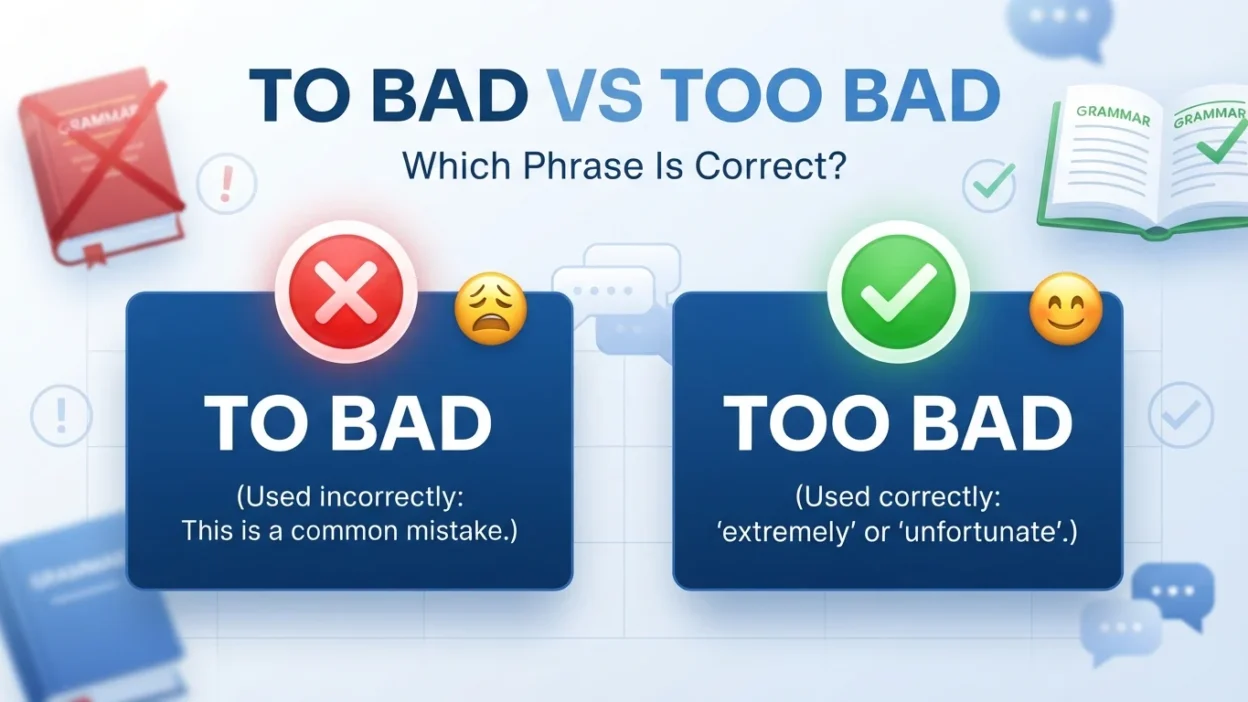
The correct phrase is “too bad.” “To bad” is a grammatical error in standard English because to is a preposition or part of an infinitive, while too means excessively or also.
Quick Answer
“Too bad” is the correct phrase.
“To bad” is incorrect in standard English.
Correct Example
- It’s too bad you couldn’t join us.
Incorrect Example
- It’s to bad you couldn’t join us.
What Does “Too Bad” Mean?
Too bad is an informal expression used to show:
- disappointment
- sympathy
- regret
- that something unfortunate happened
Depending on the context, it can also mean unfortunately or what a shame.
Examples of Too Bad in Sentences
- It’s too bad the concert was canceled.
- Too bad you missed the meeting.
- That’s too bad I hope things get better.
- It’s too bad we couldn’t stay longer.
- Too bad the weather ruined our plans.
Is “To Bad” Correct?
No. “To bad” is not a correct English phrase.
The confusion occurs because to and too are homophones they sound alike but have different meanings.
Use:
- too bad ✅
Not:
- to bad ❌
Why Is It “Too Bad”?
In this expression, too means excessively, very, or functions as part of the fixed phrase too bad, meaning what a shame.
To is generally used:
- before a verb (to eat, to learn)
- as a preposition (go to school)
It cannot correctly modify bad in this phrase.
To Bad vs Too Bad Comparison Table
| Feature | Too Bad | To Bad |
|---|---|---|
| Correct phrase | Yes | No |
| Standard English | Yes | No |
| Dictionary approved | Yes | No |
| Everyday conversation | Yes | No |
| Professional writing | Yes | No |
Word Comparison
Understanding “To” vs “Too”
Too
Too means:
- excessively
- also
- more than enough
Examples:
- It’s too expensive.
- I want to come too.
- That’s too bad.
To
To is used:
- before verbs
- as a preposition
Examples:
- I want to study.
- We went to the park.
Common Mistakes With “Too Bad”
Using “To” Instead of “Too”
Incorrect:
- It’s to bad you were sick.
Correct:
- It’s too bad you were sick.
Typing Too Quickly
Many people accidentally omit one o while typing.
Confusing Homophones
Remember:
- to = direction or infinitive
- too = also, excessively, or part of too bad
Different Uses of Too Bad
Showing Sympathy
Example:
- That’s too bad. I hope you recover soon.
Expressing Disappointment
Example:
- It’s too bad the game was postponed.
Responding to News
Example:
- Too bad you couldn’t make it.
Casual Conversation
Example:
- That’s too bad, but maybe next time.
Similar Expressions
Depending on the context, you can also say:
- what a shame
- unfortunately
- that’s unfortunate
- what a pity
- that’s disappointing
Example
- What a shame you couldn’t attend.
American vs British English Differences
There is no spelling difference.
Both American and British English use:
- too bad
Neither uses:
- to bad
Why Correct Spelling Matters
Using the correct phrase helps:
- improve readability
- strengthen professionalism
- build credibility
- avoid grammar mistakes
- communicate clearly
Using to bad may make your writing appear careless or incorrect.
Tips to Remember the Correct Phrase
Think of “Very Bad”
The phrase means something like:
- very unfortunate
Since too can mean very or excessively, it’s the correct choice.
Remember the Double “O”
The phrase always uses:
- too bad
Practice With Sentences
- It’s too bad we arrived late.
- Too bad you missed the opportunity.
(FAQs)
Which phrase is correct: to bad or too bad?
Too bad is the correct phrase.
Is “to bad” ever correct?
No. It is a grammatical error.
What does “too bad” mean?
It expresses disappointment, regret, sympathy, or that something is unfortunate.
Why is “too” used instead of “to”?
Because too is the correct word in the fixed expression too bad.
Is “too bad” used in British and American English?
Yes. Both varieties use too bad.
Can “too bad” sound rude?
Sometimes. Depending on tone, saying only “Too bad.” may sound dismissive. Adding empathy, such as “That’s too bad. I’m sorry to hear that,” often sounds kinder.
What are similar expressions?
- what a shame
- that’s unfortunate
- what a pity
- unfortunately
How can I remember the correct phrase?
Think:
- Too bad = very unfortunate.
Since too means very or excessively, it’s the correct spelling.
Final Summary
The difference between to bad vs too bad is straightforward. “Too bad” is the correct phrase and is used to express disappointment, sympathy, or regret. “To bad” is a grammatical mistake and should never be used.
Whether you’re responding to unfortunate news or describing a disappointing situation, too bad is always the correct choice.
Actionable Takeaway
Whenever you mean “what a shame” or “that’s unfortunate,” write:
- too bad ✅
Never write:
- to bad ❌
A simple memory trick:
- Too = very or also.
- Too bad = very unfortunate.
Remember the double “o” in too.