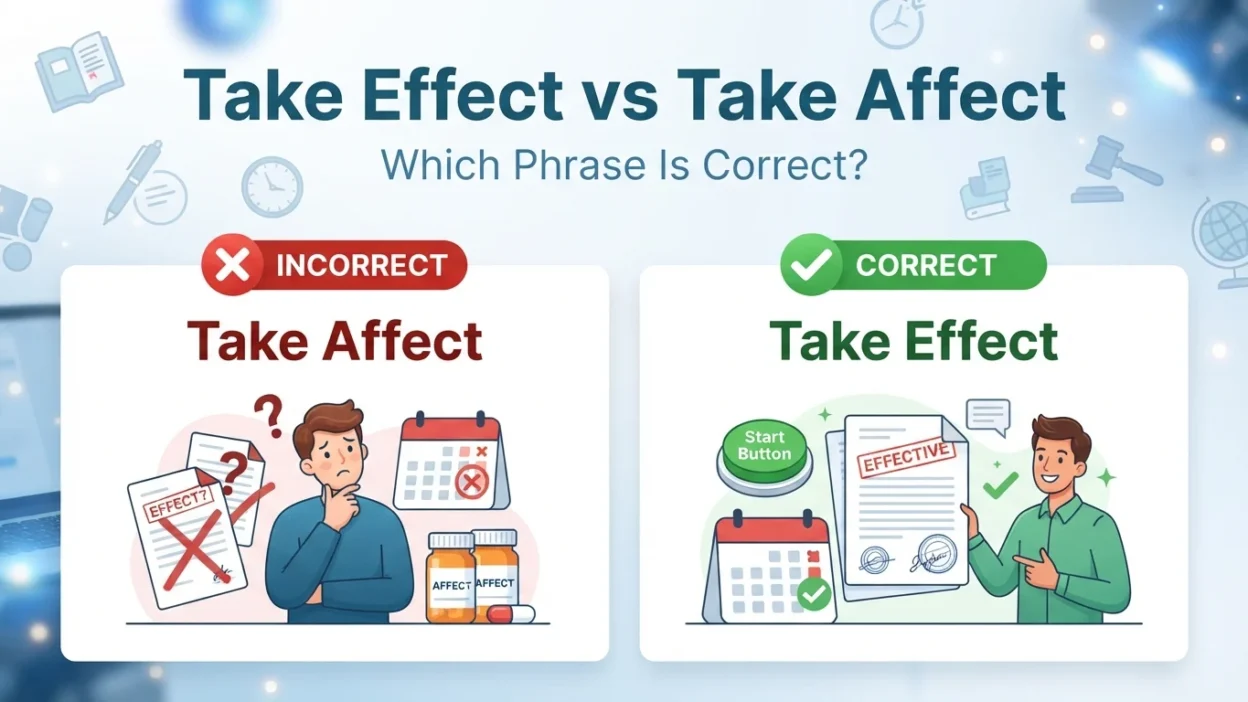
If you’ve ever wondered whether “take effect” or “take affect” is the correct phrase, you’re not alone. Since effect and affect are commonly confused words, many writers mistakenly use take affect. However, only one phrase is correct in standard English.
The correct phrase is “take effect.” “Take affect” is grammatically incorrect because effect is the noun required in this expression, while affect is usually a verb.
Quick Answer
“Take effect” is the correct phrase.
“Take affect” is incorrect in standard English.
Correct Example
- The new law will take effect next month.
Incorrect Example
- The new law will take affect next month.
What Does “Take Effect” Mean?
Take effect is an idiomatic phrase that means:
- to become active
- to start working
- to become operative
- to begin producing results
It is commonly used when talking about laws, policies, medicines, contracts, rules, and decisions.
Examples of Take Effect in Sentences
- The new policy will take effect on January 1.
- The medication should take effect within an hour.
- The price increase takes effect tomorrow.
- The contract will take effect once both parties sign it.
- The updated regulations took effect immediately.
Is “Take Affect” Correct?
No. “Take affect” is not a correct English phrase.
The confusion happens because affect and effect sound alike, but they have different meanings and grammatical roles.
Use:
- take effect ✅
Not:
- take affect ❌
Why Is It “Take Effect”?
In this expression, effect is a noun meaning result, operation, or implementation.
The phrase literally means “to come into operation” or “to begin having an effect.”
Affect, on the other hand, is usually a verb meaning to influence.
Take Effect vs Take Affect Comparison Table
| Feature | Take Effect | Take Affect |
|---|---|---|
| Correct phrase | Yes | No |
| Standard English | Yes | No |
| Dictionary approved | Yes | No |
| Professional writing | Yes | No |
| Legal documents | Yes | No |
Word Comparison
Understanding Affect vs Effect
Effect (Noun)
Means:
- result
- outcome
- operation
- consequence
Examples:
- The medicine had a positive effect.
- The changes will take effect tomorrow.
Affect (Verb)
Means:
- to influence
- to change
- to impact
Examples:
- Stress can affect your sleep.
- Weather affects travel plans.
Common Mistakes With “Take Effect”
Using Affect Instead of Effect
Incorrect:
- The rule will take affect next week.
Correct:
- The rule will take effect next week.
Confusing Nouns and Verbs
Remember:
- effect = noun
- affect = verb
Since the phrase requires a noun, effect is correct.
Different Uses of Take Effect
Laws
Example:
- The legislation will take effect in July.
Medicine
Example:
- The painkiller should take effect within 30 minutes.
Business
Example:
- The salary increase takes effect next month.
Contracts
Example:
- The agreement will take effect after approval.
Similar Expressions
Depending on the context, you can also use:
- come into effect
- become effective
- go into effect
- become operative
- start working
Example
- The new rules will go into effect tomorrow.
American vs British English Differences
There is a small usage difference:
- American English commonly uses take effect and go into effect.
- British English commonly uses take effect and come into effect.
However, take effect is correct in both varieties.
Why Correct Spelling Matters
Using the correct phrase helps:
- improve readability
- strengthen professionalism
- build credibility
- avoid grammar mistakes
- communicate clearly
Using take affect can make your writing appear incorrect.
Tips to Remember the Correct Phrase
Think About the Meaning
The phrase means to become effective, so it requires the noun:
- effect
Remember the Grammar Rule
- Affect = verb
- Effect = noun
The phrase always uses the noun.
Practice With Sentences
- The policy will take effect next week.
- The medicine took effect quickly.
Frequently Asked Questions (FAQs)
Which phrase is correct: take effect or take affect?
Take effect is the correct phrase.
Is “take affect” ever correct?
No. It is a grammatical mistake.
What does “take effect” mean?
It means to begin working, become active, or start producing results.
Why is “effect” used instead of “affect”?
Because effect is the noun required in the idiomatic phrase take effect.
Is “take effect” used in British and American English?
Yes. It is correct in both.
What is the difference between affect and effect?
- Affect = usually a verb meaning to influence.
- Effect = usually a noun meaning result or outcome.
What are similar phrases?
- go into effect
- come into effect
- become effective
- become operative
How can I remember the correct phrase?
Think:
- Take effect = become effective.
Both words share the root effect, making the correct phrase easier to remember.
Final Summary
The difference between take effect vs take affect is simple. “Take effect” is the correct phrase because effect is the noun meaning that something has become active or operative. “Take affect” is incorrect and should never be used in standard English.
If you’re writing about laws, policies, contracts, or medicine, take effect is always the correct choice.
Actionable Takeaway
Whenever you mean “to become active” or “to start working,” write:
- take effect ✅
Never write:
- take affect ❌
A simple memory trick:
- Effect = result.
- Something takes effect when it starts producing results.