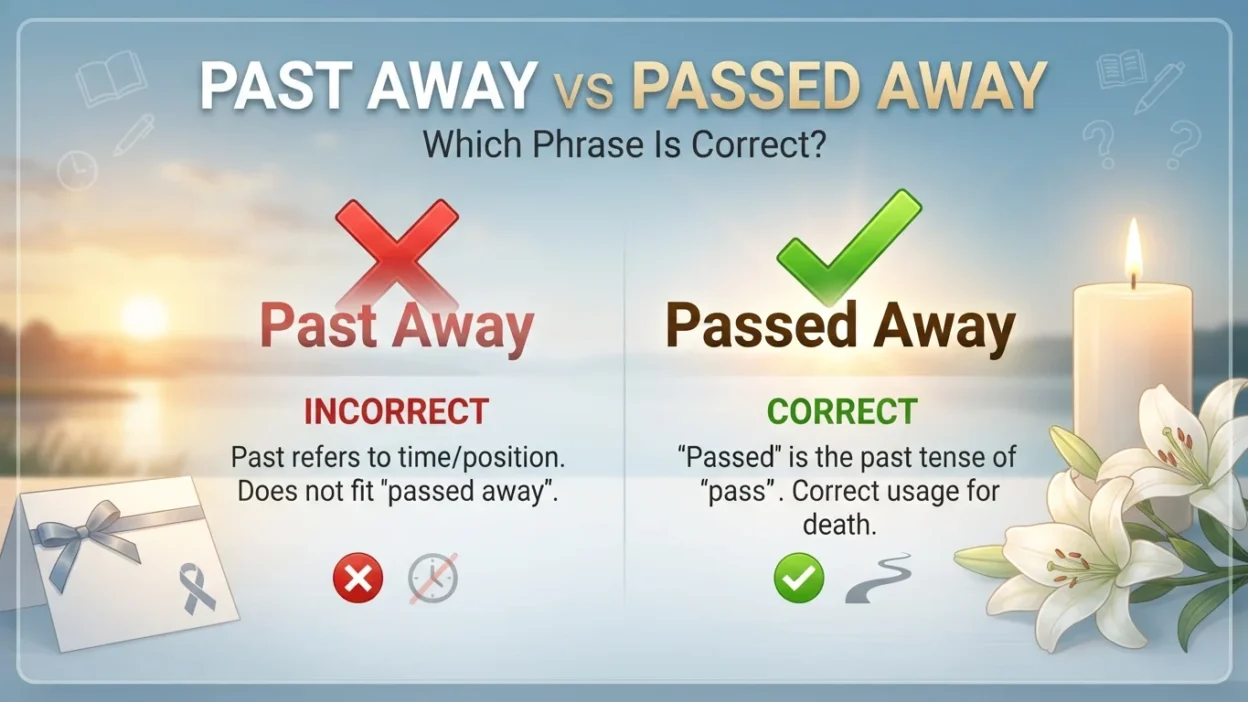
If you’ve ever wondered whether “past away” or “passed away” is the correct phrase, you’re not alone. Because past and passed sound the same, they are often confused in writing. However, only one phrase is correct when referring to someone’s death.
The correct phrase is “passed away.” “Past away” is incorrect in standard English because past is not the correct verb form in this expression.
Quick Answer
“Passed away” is the correct phrase.
“Past away” is incorrect in standard English.
Correct Example
- Her grandfather passed away peacefully last year.
Incorrect Example
- Her grandfather past away peacefully last year.
What Does “Passed Away” Mean?
Passed away is a polite and respectful euphemism for died.
It is commonly used in:
- obituaries
- condolences
- news reports
- conversations about someone’s death
- formal writing
The phrase softens the directness of the word died.
Examples of Passed Away in Sentences
- My grandmother passed away at the age of 92.
- We were saddened to hear that he passed away.
- The beloved actor passed away peacefully.
- Her father passed away after a long illness.
- Our thoughts are with the family after their loved one passed away.
Is Past Away a Real Phrase?
No, “past away” is not a correct English phrase.
The confusion occurs because past and passed are pronounced the same, but they have different meanings.
Standard English uses:
- passed away
Not:
- past away
Why Is It “Passed Away”?
The phrase comes from the verb pass, whose past tense is passed.
Rule:
In this expression:
- passed = past tense of the verb pass
- away = forms the phrasal verb pass away
By contrast, past is usually a preposition, adjective, adverb, or noun—not the past tense of pass.
Past Away vs Passed Away Comparison Table
| Feature | Passed Away | Past Away |
|---|---|---|
| Correct spelling | Yes | No |
| Standard English | Yes | No |
| Dictionary approved | Yes | No |
| Formal writing | Yes | No |
| Used in obituaries | Yes | No |
Understanding “Past” vs “Passed”
Passed
Passed is the past tense of the verb pass.
Examples:
- She passed the exam.
- He passed the ball.
- Their neighbor passed away.
Past
Past usually refers to time, position, or movement beyond something.
Examples:
- We drove past the park.
- That’s in the past.
- It was past midnight.
Common Mistakes With Passed Away
Using “Past” Instead of “Passed”
Incorrect:
- My uncle past away last week.
Correct:
- My uncle passed away last week.
Confusing the Homophones
Remember:
- passed = verb
- past = noun, adjective, adverb, or preposition
Different Uses of Passed Away
Obituaries
Example:
- The author passed away peacefully.
Condolence Messages
Example:
- We are sorry to hear your mother passed away.
News Reports
Example:
- The former president passed away at home.
Everyday Conversation
Example:
- My childhood teacher passed away a few years ago.
Synonyms for Passed Away
Depending on the tone and context, alternatives include:
- died
- departed
- deceased
- lost their life
- breathed their last (literary)
Example
- The veteran passed away surrounded by family.
American vs British English Differences
There is no spelling difference.
Both American and British English use:
- passed away
Neither uses:
- past away
Why Correct Spelling Matters
Using the correct phrase improves:
- professionalism
- clarity
- credibility
- respectful communication
- writing quality
Misspelling passed away as past away can:
- distract readers
- appear careless
- undermine formal or sensitive writing
Tips to Remember the Correct Spelling
Think of the Verb “Pass”
The phrase uses the verb pass, so the past tense is:
- passed
Remember the Rule
- pass → passed
- pass away → passed away
Practice Full Sentences
Example:
- Her beloved grandmother passed away peacefully.
FAQs About Past Away vs Passed Away
Which phrase is correct: past away or passed away?
Passed away is the correct phrase.
Is past away a real English phrase?
No. It is a common spelling mistake.
What does passed away mean?
It is a respectful way of saying that someone died.
Why do people write past away?
Because past and passed are pronounced the same, making them easy to confuse.
Is passed away appropriate in formal writing?
Yes. It is commonly used in obituaries, condolences, and respectful communication.
Is passed away used in British and American English?
Yes. Both varieties use passed away.
What is the difference between past and passed?
- Passed is the past tense of the verb pass.
- Past usually refers to time or position.
How can I remember the correct phrase?
Think:
- Pass → Passed
- Therefore: Passed away
Final Summary
The difference between past away vs passed away is straightforward. “Passed away” is the correct phrase because passed is the past tense of the verb pass. “Past away” is a common spelling mistake and should never be used in standard English.
Whether you’re writing a condolence message, obituary, news article, or personal note, passed away is the respectful and grammatically correct choice.
Actionable Takeaway
Whenever you’re referring to someone’s death respectfully, write:
- passed away ✅
Never write:
- past away ❌
A simple memory trick:
- Pass → Passed
- Therefore: Pass away → Passed away
Remembering this verb pattern will help you avoid this common mistake.