
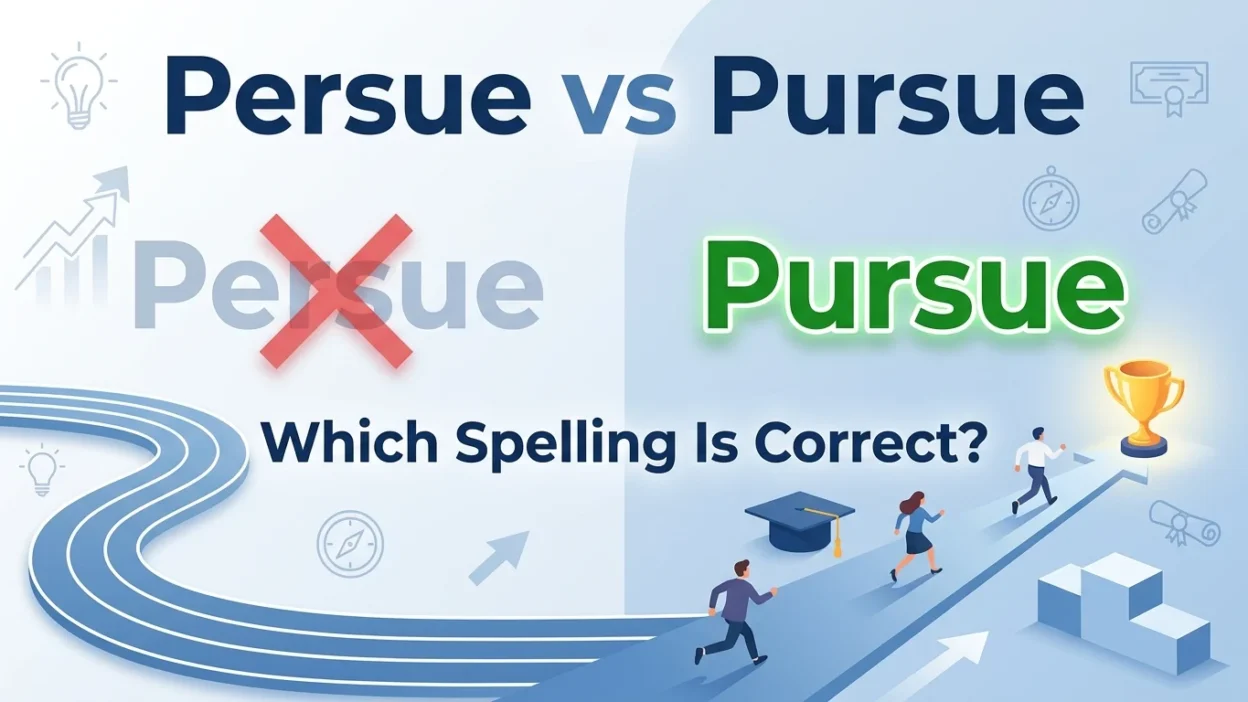
English spelling can sometimes be confusing, especially when words sound similar to how they are pronounced. One common mistake many people make is writing “persue” instead of “pursue.” Because the pronunciation can feel tricky, it is easy to mix up the vowel order.
The correct spelling is “pursue.” Meanwhile, “persue” is considered incorrect in standard English. Understanding the difference can help improve your grammar, writing confidence, and professionalism in essays, emails, business communication, and everyday writing.
Quick Answer
“Pursue” is the correct spelling.
“Persue” is incorrect in standard English.
Correct Example
- She decided to pursue a career in medicine.
Incorrect Example
- She decided to persue a career in medicine.
What Does Pursue Mean?
“Pursue” is a verb that means:
- to follow or chase something
- to continue working toward a goal
- to seek achievement
- to engage in an activity
It is commonly used in:
- education
- careers
- sports
- business
- personal development
Examples of Pursue in Sentences
- He wants to pursue higher education.
- Detectives pursued the suspect.
- They plan to pursue new opportunities.
- She pursued her dreams despite challenges.
- The company is pursuing growth strategies.
Is Persue a Real Word?
No, “persue” is not considered a correct English word.
It is simply a spelling mistake caused by mixing up the vowels in:
- pursue
Standard dictionaries and grammar guides only recognize:
- pursue
Why Do People Write “Persue”?
The mistake usually happens because:
- pronunciation feels misleading
- “er” and “ur” vowel combinations are confusing
- fast typing causes spelling errors
However, the correct spelling is:
- pursue
Not:
- persue
Persue vs Pursue Comparison Table
| Feature | Pursue | Persue |
|---|---|---|
| Correct spelling | Yes | No |
| Standard English | Accepted | Incorrect |
| Dictionary word | Yes | No |
| Used professionally | Yes | No |
| Grammar approved | Yes | No |
Word Forms of Pursue
| Verb Form | Correct Word |
|---|---|
| Base verb | pursue |
| Present participle | pursuing |
| Past tense | pursued |
| Past participle | pursued |
Correct Word Structure
pursue=persue
Common Uses of Pursue
Pursuing Goals
Example:
- Students pursue academic success.
Pursuing Careers
Example:
- She pursued a career in engineering.
Pursuing Dreams
Example:
- Never stop pursuing your dreams.
Pursuing Someone
Example:
- Police pursued the fleeing car.
Common Mistakes With Pursue
Switching the Vowels
Incorrect:
- He wants to persue acting.
Correct:
- He wants to pursue acting.
Pronunciation Based Spelling
Some writers assume the word begins with:
- per-
because of how it sounds quickly in speech.
Typing Errors
Fast typing often causes vowel placement mistakes.
Synonyms for Pursue
Depending on context, similar words include:
- chase
- follow
- seek
- continue
- strive for
- aim for
Example
- She continued to pursue her ambitions.
Opposites of Pursue
Antonyms include:
- avoid
- abandon
- ignore
- quit
- neglect
Example
- He abandoned the plan instead of pursuing it.
American vs British English Differences
There is no spelling difference between American English and British English for this word.
Both use:
- pursue
Neither standard variety uses:
- persue
Why Correct Spelling Matters
Correct spelling improves:
- professionalism
- readability
- communication clarity
- grammar accuracy
- writing confidence
Misspellings like “persue” may:
- distract readers
- reduce credibility
- appear careless
Common Phrases Using Pursue
Pursue a Career
Meaning: work toward a profession.
Example:
- She wants to pursue a career in law.
Pursue Excellence
Meaning: strive for high standards.
Example:
- Successful athletes pursue excellence daily.
Pursue Happiness
Meaning: seek fulfillment or joy.
Example:
- Everyone deserves the chance to pursue happiness.
Pursue Opportunities
Meaning: seek new possibilities.
Example:
- Entrepreneurs pursue business opportunities worldwide.
Tips to Remember the Correct Spelling
Remember “PUR”
The word starts with:
- pur-
Not:
- per-
Think of “Pure Goals”
A memory trick:
- pursue your pure goals
Both begin with:
- pur
Practice Full Sentences
Example:
- I want to pursue my dreams.
FAQs
Which spelling is correct: persue or pursue?
“Pursue” is the correct spelling.
Is persue a real word?
No. “Persue” is considered a spelling mistake.
What does pursue mean?
It means to follow, seek, continue, or strive toward something.
Why do people spell pursue incorrectly?
Usually because pronunciation and vowel order can feel confusing.
What is the past tense of pursue?
The past tense is:
- pursued
Is pursue used in British and American English?
Yes. Both varieties use “pursue.”
What are synonyms for pursue?
Common synonyms include chase, follow, seek, and strive for.
How can I remember the spelling?
Remember:
- pursue starts with “pur”
Not:
- per
Final Summary
The difference between persue vs pursue is simple once you know the correct spelling. “Pursue” is the accepted and standard English word used to describe following, striving for, or working toward something. “Persue” is simply a misspelling that should be avoided in formal and informal writing.
Whether you are writing essays, emails, resumes, blog posts, or professional documents, using “pursue” correctly helps your writing appear polished, accurate, and trustworthy. Small spelling improvements like this can significantly strengthen communication clarity and professionalism.
Actionable Takeaway
Whenever you want to describe chasing a goal, following a path, or striving toward success, always write:
- pursue
Not:
- persue
Remember that the correct spelling begins with:
- pur-
This simple memory trick can help you avoid a very common English spelling mistake.