English grammar can sometimes be confusing, especially when two words sound exactly alike but have completely different meanings. One of the most common examples is “whos” vs “whose.” Many writers accidentally leave out an apostrophe or use the wrong word entirely, leading to grammar mistakes in emails, essays, social media posts, and professional writing.
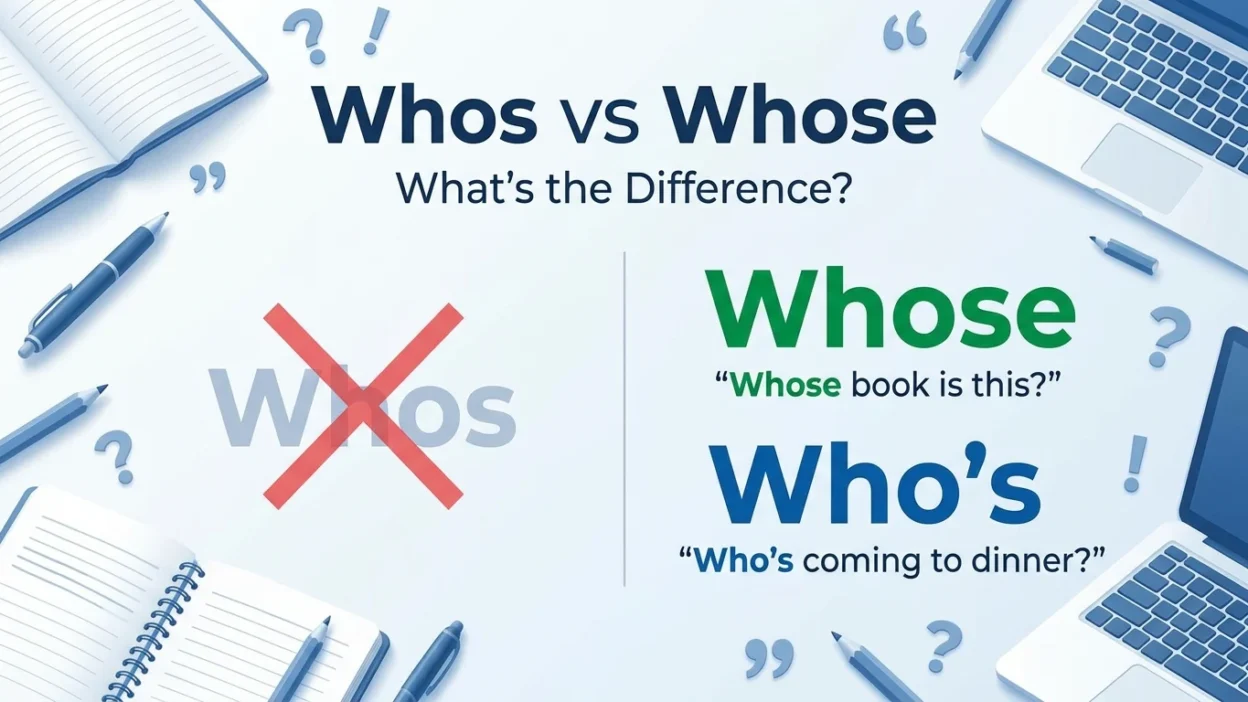
The good news is that the difference between these words is actually simple once you understand their roles in a sentence. “Whose” is a correct English word used to show possession, while “whos” without an apostrophe is generally incorrect in standard English.
Most of the time, people actually mean to write “who’s,” which is a contraction of “who is” or “who has.”
Quick Answer
“Whose” is correct when showing possession.
“Whos” is usually incorrect.
In many cases, people actually mean:
- who’s = who is / who has
Correct Examples
- Whose jacket is this?
- Who’s coming to dinner tonight?
Incorrect Example
- Whos jacket is this?
What Does Whose Mean?
“Whose” is a possessive pronoun and determiner.
It shows ownership or relationship.
Meaning of Whose
It means:
- belonging to whom
- associated with whom
Examples of Whose in Sentences
- Whose phone is ringing?
- Do you know whose bag this is?
- She met a writer whose books became famous.
- Whose turn is it now?
- I wonder whose idea this was.
Is Whos a Real Word?
No, “whos” without an apostrophe is generally not accepted in standard English grammar.
Usually, people accidentally write:
- whos
when they actually mean:
- whose
or - who’s
What Does Who’s Mean?
“Who’s” is a contraction.
It combines:
- who + is
or - who + has
Examples of Who’s in Sentences
- Who’s at the door?
- Who’s ready for lunch?
- She’s the person who’s been helping us.
- Who’s finished the project?
Whos vs Whose Comparison Table
| Word | Meaning | Correct Usage |
|---|---|---|
| whose | shows possession | Yes |
| who’s | who is / who has | Yes |
| whos | usually incorrect | No |
Easy Trick to Remember the Difference
Whose = Possession
Think:
- whose car
- whose idea
- whose jacket
It works like:
- his
- her
- their
Who’s = Who Is
Replace “who’s” with:
- who is
or - who has
If the sentence still makes sense, “who’s” is correct.
Example
- Who’s coming today?
→ Who is coming today?
This works perfectly.
Common Mistakes With Whose and Who’s
Using Whose Instead of Who’s
Incorrect:
- Whose going to the party?
Correct:
- Who’s going to the party?
Using Who’s Instead of Whose
Incorrect:
- Who’s backpack is this?
Correct:
- Whose backpack is this?
Forgetting the Apostrophe
Incorrect:
- Whos calling me?
Correct:
- Who’s calling me?
Grammar Rule Behind Whose
“Whose” is possessive, similar to:
- his
- hers
- theirs
Correct Structure
whose=possession
Grammar Rule Behind Who’s
“Who’s” is always a contraction.
Correct Structure
who’s=who is / who has
Examples Comparing Whose and Who’s
| Correct Sentence | Meaning |
|---|---|
| Whose shoes are these? | ownership |
| Who’s wearing my shoes? | who is |
| Whose dog barked? | possession |
| Who’s been here before? | who has |
American vs British English Differences
There is no difference between American and British English for:
- whose
- who’s
Both English varieties follow the same grammar rules.
Why Correct Usage Matters
Using the correct word improves:
- grammar accuracy
- professionalism
- readability
- communication clarity
- writing confidence
Mistakes involving “whose” and “who’s” are very noticeable in formal writing.
Common Phrases Using Whose
Whose Idea
Meaning: who owns or created the idea.
Example:
- Whose idea was this project?
Whose Responsibility
Meaning: who is accountable.
Example:
- Whose responsibility is cleaning the office?
Whose Fault
Meaning: who caused the problem.
Example:
- Whose fault was the mistake?
Common Phrases Using Who’s
Who’s There?
Meaning: who is present.
Example:
- Who’s there at the door?
Who’s Next?
Meaning: who is the next person.
Example:
- Who’s next in line?
Who’s Been Here?
Meaning: who has visited.
Example:
- Who’s been using my computer?
Tips to Remember the Difference
Look for Ownership
If the sentence involves possession, use:
- whose
Expand the Contraction
If you can replace the word with:
- who is
or - who has
Use:
- who’s
Avoid “Whos”
Without an apostrophe, “whos” is usually incorrect.
FAQs
Is whos a correct word?
No. “Whos” without an apostrophe is generally incorrect in standard English.
What is the difference between whose and who’s?
“Whose” shows possession, while “who’s” means “who is” or “who has.”
How do I know when to use whose?
Use “whose” when asking who owns something.
Is who’s always a contraction?
Yes. “Who’s” always means “who is” or “who has.”
Which sentence is correct: whose coming or who’s coming?
The correct sentence is:
- Who’s coming?
Can whose refer to people and things?
Yes. It can refer to both people and objects.
Do British and American English use different rules?
No. Both use the same grammar rules.
Why do people confuse these words?
Because they sound identical when spoken.
Final Summary
The difference between whos vs whose becomes easy once you understand grammar roles. “Whose” is the correct word for showing possession, while “who’s” is a contraction meaning “who is” or “who has.” Meanwhile, “whos” without an apostrophe is generally incorrect in standard English.
Whether you are writing essays, emails, blog posts, or social media captions, using “whose” and “who’s” correctly helps your writing appear polished, accurate, and professional. Small grammar details like these can greatly improve readability and communication clarity.
Actionable Takeaway
Whenever you write:
- use “whose” for ownership
- use “who’s” for “who is” or “who has”
- avoid writing “whos” without an apostrophe
Remembering this simple grammar distinction will instantly improve your English writing accuracy.