English can be tricky because some words sound exactly alike but have completely different meanings and spellings. One of the most common spelling and grammar confusions involves “thier,” “their,” and “there.” Many people accidentally type “thier” when they actually mean “their,” while others mix up “their” and “there” because both are pronounced similarly.
The good news is that the difference becomes much easier once you understand the role each word plays in a sentence.
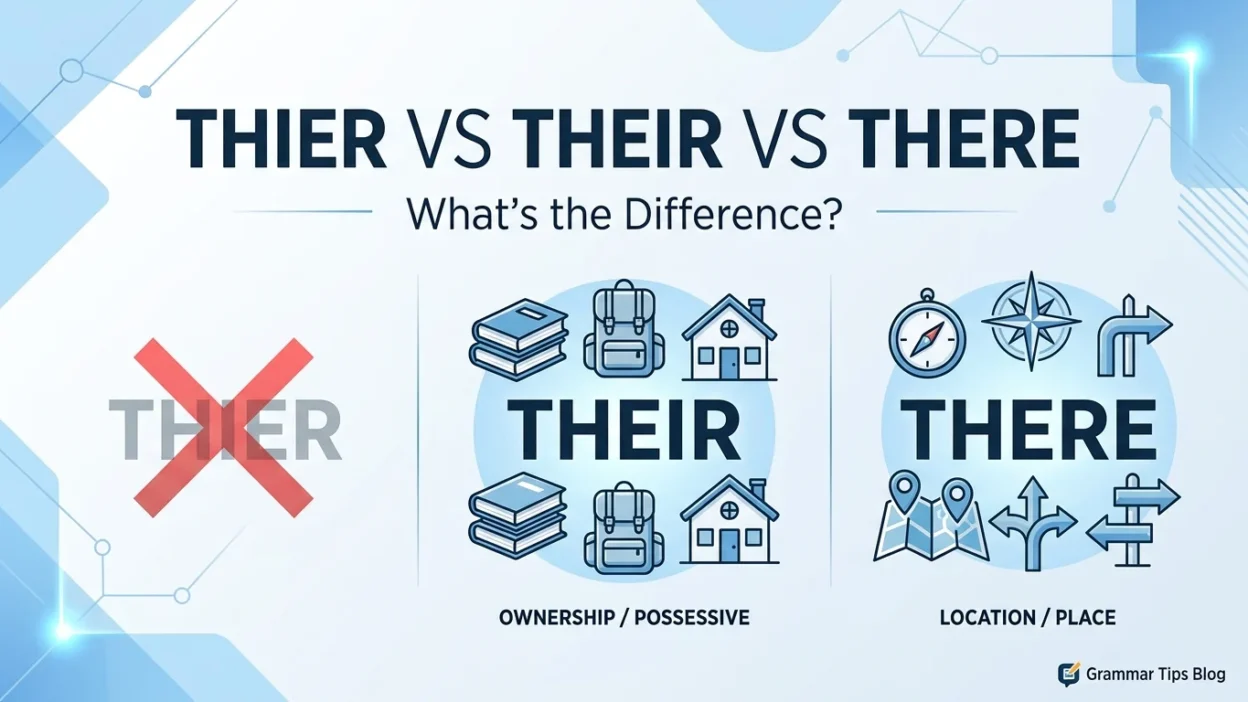
“Their” shows possession, “there” refers to a place or existence, and “thier” is simply a misspelling. Learning these distinctions can instantly improve your writing clarity, grammar accuracy, and confidence.
Quick Answer
- “Their” = shows ownership or possession
- “There” = refers to place, position, or existence
- “Thier” = incorrect spelling
Correct Examples
- Their car is parked outside.
- The keys are over there.
Incorrect Example
- Thier car is parked outside.
What Does Their Mean?
“Their” is a possessive determiner and pronoun.
It shows that something belongs to:
- people
- groups
- individuals
Examples of Their in Sentences
- Their house is beautiful.
- The students finished their homework.
- The team celebrated their victory.
- Parents care deeply about their children.
- Their opinions matter.
What Does There Mean?
“There” usually refers to:
- a place
- location
- existence
It is commonly used in everyday English.
Examples of There in Sentences
- The restaurant is over there.
- There are many books on the shelf.
- We went there yesterday.
- Is there a problem?
- There was a loud noise outside.
Is Thier a Real Word?
No, “thier” is not a correct English word.
It is simply a common spelling mistake caused by reversing:
- i
and - e
The correct spelling is:
- their
Thier vs Their vs There Comparison Table
| Word | Meaning | Correct Usage |
|---|---|---|
| their | possession or ownership | Yes |
| there | place or existence | Yes |
| thier | misspelling | No |
Easy Trick to Remember the Difference
Their = Ownership
“Their” contains the word:
- heir
An heir owns or inherits something, which can help you remember that “their” relates to possession.
There = Place
“There” contains:
- here
Both words relate to location.
Thier = Incorrect
If you see:
- thier
It is almost always a spelling error.
Grammar Rule Behind Their
“Their” works like:
- my
- your
- his
- her
- our
It always shows ownership.
Correct Structure
their=possession
Grammar Rule Behind There
“There” usually refers to:
- location
- existence
- direction
Correct Structure
there=place or existence
Examples Comparing Their and There
| Correct Sentence | Meaning |
|---|---|
| Their dog is friendly. | ownership |
| The dog is over there. | location |
| Their books are missing. | possession |
| There is a book on the table. | existence |
Common Mistakes With Their and There
Mixing Up Possession and Place
Incorrect:
- There house is huge.
Correct:
- Their house is huge.
Misspelling Their as Thier
Incorrect:
- Thier teacher was absent.
Correct:
- Their teacher was absent.
Using Their Instead of There
Incorrect:
- Their are many options.
Correct:
- There are many options.
Why “Thier” Happens So Often
The spelling mistake occurs because:
- “i before e” confusion is common
- fast typing swaps letters accidentally
- pronunciation does not clearly show spelling
However, the correct spelling is always:
- their
Common Phrases Using Their
Their Best
Meaning: someone’s highest effort.
Example:
- The players gave their best performance.
Their Own
Meaning: belonging personally to them.
Example:
- Everyone deserves their own space.
Their Responsibility
Meaning: something they are accountable for.
Example:
- Safety is their responsibility.
Common Phrases Using There
There Is / There Are
Meaning: existence.
Example:
- There are many reasons to celebrate.
Over There
Meaning: in another location.
Example:
- The bus stop is over there.
There You Go
Meaning: acknowledgment or completion.
Example:
- There you go your order is ready.
American vs British English Differences
There is no spelling difference between American English and British English for:
- their
- there
Both English varieties treat:
- thier
as incorrect.
Why Correct Usage Matters
Correct grammar improves:
- professionalism
- readability
- communication clarity
- writing confidence
- credibility
Mistakes involving “their” and “there” are very noticeable in formal writing
Visual Comparison Chart
Thier vs Their vs There Usage Accuracy
Comparison of correct and incorrect usage in standard English grammar.TheirThereThier0%25%50%75%100%
Tips to Remember the Correct Spelling
Think “Heir” Inside Their
“Heir” relates to ownership.
That helps you remember:
- their = possession
Think “Here” Inside There
“Here” relates to location.
That helps you remember:
- there = place
Watch Letter Order Carefully
Correct spelling:
- their
Not:
- thier
FAQs
Is thier a correct word?
No. “Thier” is a spelling mistake.
What is the difference between their and there?
“Their” shows possession, while “there” refers to location or existence.
How do I remember their vs there?
Think:
- their = ownership
- there = place
Is there used for locations?
Yes. “There” commonly refers to places or positions.
Why do people spell their as thier?
Usually because of typing errors or confusion with “i before e” spelling patterns.
Can their refer to one person?
Yes. Modern English sometimes uses “their” as a singular gender-neutral pronoun.
Which sentence is correct: their is or there is?
The correct phrase is:
- there is
Do British and American English spell these words differently?
No. Both varieties use the same spellings.
Final Summary
The difference between thier vs their vs there becomes much easier once you understand their meanings and grammar roles. “Their” is the correct word for showing possession, “there” refers to place or existence, and “thier” is simply an incorrect spelling that should be avoided.
Whether you are writing essays, blog posts, emails, or social media captions, using “their” and “there” correctly helps your writing appear polished, accurate, and professional. Small spelling improvements like this can significantly improve communication clarity and reader trust.
Actionable Takeaway
Whenever you write:
- use “their” for ownership
- use “there” for place or existence
- avoid “thier” completely
Remembering these simple grammar distinctions will instantly strengthen your English writing skills.