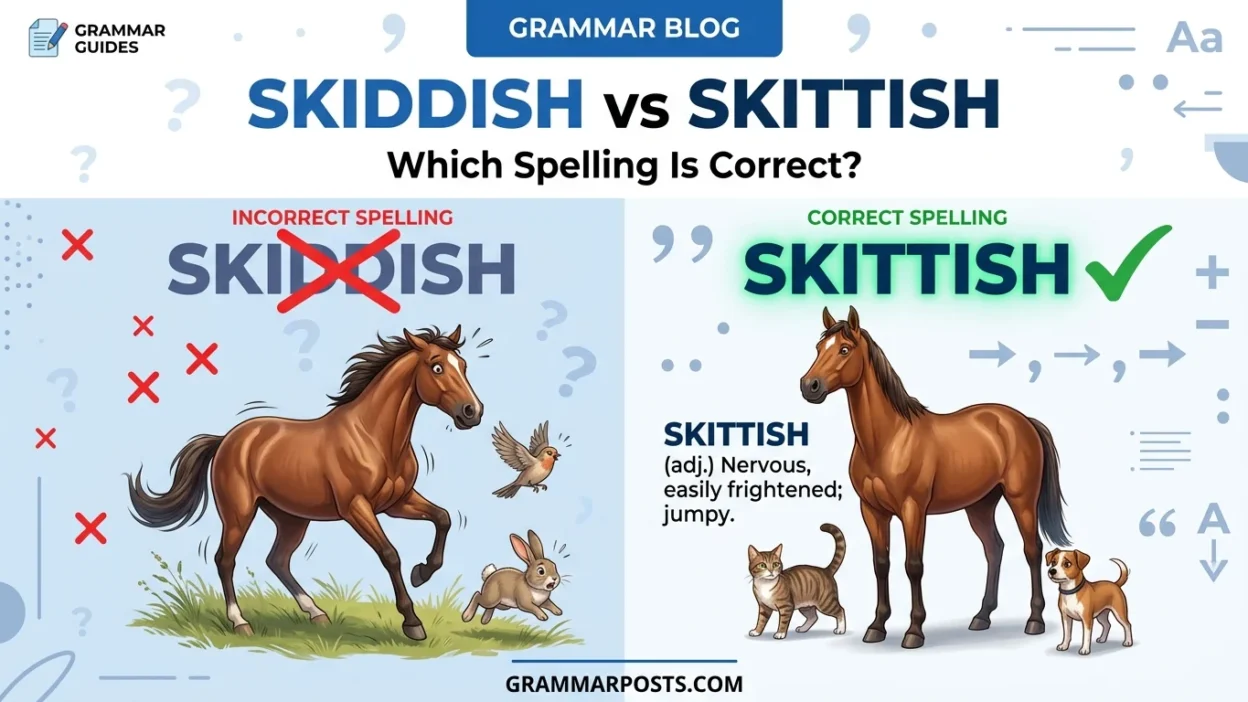
If you’ve ever written “skiddish” and wondered whether it should actually be “skittish,” you’re not alone. These two spellings are often confused because they sound very similar in everyday speech. In fact, many people use skiddish in conversation without realizing it’s not the standard dictionary spelling.
The truth is that “skittish” is the correct English word. While “skiddish” occasionally appears in informal speech and online writing, it is generally considered a misspelling or nonstandard variant. Knowing the difference will help you write more accurately and confidently.
Quick Answer
“Skittish” is the correct spelling.
“Skiddish” is a nonstandard spelling and is generally considered incorrect in formal English.
Correct Example
- The horse became skittish during the storm.
Incorrect Example
- The horse became skiddish during the storm.
What Does Skittish Mean?
Skittish is an adjective that describes someone or something that is:
- easily frightened
- nervous
- jumpy
- easily startled
- reluctant to commit
It is often used for animals, especially horses, but can also describe people and situations.
Examples of Skittish in Sentences
- The skittish horse backed away from the noise.
- Investors became skittish after the market decline.
- She felt skittish about speaking in public.
- The dog was skittish around strangers.
- Customers grew skittish after hearing the rumors.
Is Skiddish a Real Word?
Skiddish appears in some informal conversations and regional speech, but it is not considered the standard spelling in modern English.
Most dictionaries recognize:
- skittish
Not:
- skiddish
For professional, academic, and formal writing, always use:
- skittish
Why Do People Say “Skiddish”?
There are several reasons:
- it sounds similar to skittish
- regional dialects sometimes influence pronunciation
- people may learn the word by hearing it rather than reading it
- the ending -dish feels natural to some speakers
Despite its occasional use in speech, the accepted spelling remains:
- skittish
Skiddish vs Skittish Comparison Table
| Feature | Skittish | Skiddish |
|---|---|---|
| Correct spelling | Yes | No |
| Dictionary approved | Yes | No |
| Standard English | Yes | No |
| Formal writing | Yes | No |
| Informal spoken usage | Sometimes | Sometimes |
Correct Word Structure
skittish=skiddish
Common Mistakes With Skittish
Writing the Word as “Skiddish”
Incorrect:
- The puppy seemed skiddish around visitors.
Correct:
- The puppy seemed skittish around visitors.
Spelling Based on Pronunciation
Many people hear the word spoken and assume it ends with:
- dish
instead of:
- tish
Learning the Word Orally
Words learned through conversation are often misspelled when first written.
Different Uses of Skittish
Describing Animals
Example:
- The skittish deer ran into the woods.
Describing People
Example:
- He felt skittish before the interview.
Financial Markets
Example:
- Investors became skittish about economic uncertainty.
Relationships and Commitments
Example:
- She was skittish about making a long-term commitment.
Common Phrases Using Skittish
Skittish Horse
Meaning: a horse that is easily startled.
Example:
- The rider carefully handled the skittish horse.
Skittish Investor
Meaning: a nervous investor.
Example:
- Skittish investors sold their shares quickly.
Skittish Behavior
Meaning: nervous or cautious actions.
Example:
- The animal’s skittish behavior suggested fear.
Skittish About Change
Meaning: hesitant or nervous regarding change.
Example:
- Employees were skittish about the new policy.
Synonyms for Skittish
Depending on context, similar words include:
- nervous
- jumpy
- anxious
- timid
- uneasy
Example
- The nervous and skittish horse avoided crowds.
Opposites of Skittish
Antonyms include:
- calm
- confident
- relaxed
- fearless
- composed
Example
- Unlike the other horses, this one remained calm.
American vs British English Differences
There is no spelling difference between American English and British English.
Both use:
- skittish
Neither uses:
- skiddish
as the standard spelling.
Why Correct Spelling Matters
Using the correct spelling improves:
- professionalism
- readability
- credibility
- communication clarity
- writing quality
Using skiddish in formal writing may:
- distract readers
- appear incorrect
- reduce confidence in your writing
Tips to Remember the Correct Spelling
Think of Double “T”
Correct:
- skittish
Not:
- skiddish
Associate It With Nervousness
Imagine a nervous horse that is:
- skittish
Practice Full Sentences
Example:
- The loud fireworks made the dog skittish.
FAQs
Which spelling is correct: skiddish or skittish?
Skittish is the correct spelling.
Is skiddish a real word?
It may appear in informal speech, but it is not considered standard English.
What does skittish mean?
It means nervous, jumpy, easily frightened, or hesitant.
Why do people say skiddish?
Usually because they learned the word through speech rather than reading.
Is skittish used in British and American English?
Yes. Both varieties use skittish.
What are synonyms for skittish?
Common synonyms include nervous, anxious, jumpy, timid, and uneasy.
Can skittish describe people?
Yes. It can describe people who are nervous or hesitant.
How can I remember the correct spelling?
Remember:
- ski + tt + ish = skittish
The double t is the key.
Final Summary
The difference between skiddish vs skittish is clear. “Skittish” is the correct and accepted English spelling used to describe someone or something that is nervous, easily startled, or hesitant. “Skiddish” is a nonstandard spelling that occasionally appears in speech but is generally considered incorrect in formal writing.
Whether you’re describing a nervous horse, a cautious investor, or a hesitant person, skittish is the spelling that dictionaries, editors, and readers expect. Using the correct form helps your writing appear polished and professional.
Actionable Takeaway
Whenever you mean nervous, jumpy, or easily frightened, always write:
- skittish
Not:
- skiddish
A simple memory trick:
- skittish has a double “t.”
Remembering the double t can help you avoid this common spelling mistake.