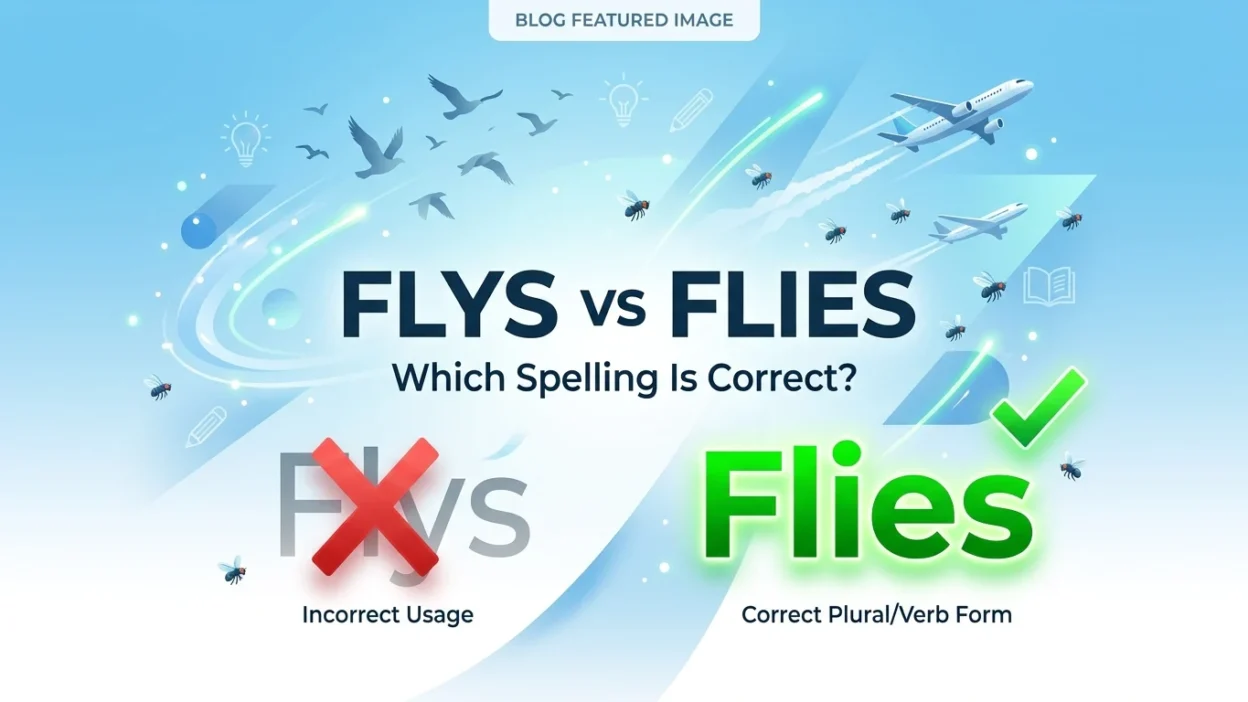
English grammar can sometimes feel confusing, especially when plural nouns and verb forms change spelling unexpectedly. One common example is “flys” vs “flies.” Since both words occasionally appear online, many people wonder which spelling is actually correct and when each one should be used.
The answer depends on the context. In most situations, “flies” is the correct spelling because it is the plural form of “fly” and also the third person singular form of the verb “fly.”
Meanwhile, “flys” is extremely rare and usually considered incorrect in everyday writing, though it may appear as a proper noun or specialized term in limited contexts.
Quick Answer
“Flies” is the correct spelling in most situations.
“Flys” is usually incorrect in standard English.
Correct Examples
- The bird flies south for winter.
- Flies are common in summer.
Incorrect Example
- The bird flys south for winter.
What Does Flies Mean?
“Flies” can function as:
- the plural form of the noun “fly”
- the third-person singular form of the verb “fly”
Flies as a Plural Noun
A “fly” is a small flying insect.
Plural:
- one fly
- two flies
Example Sentences
- Flies were buzzing around the kitchen.
- The window kept insects and flies outside.
Flies as a Verb
“Flies” is also the correct verb form used with:
- he
- she
- it
Example Sentences
- She flies to London every month.
- The airplane flies above the clouds.
- Time flies when you are having fun.
Is Flys a Real Word?
In standard English grammar, “flys” is usually considered incorrect.
However, there are a few rare exceptions:
- some surnames or business names may use “Flys”
- it can occasionally appear in specialized technical usage
In normal grammar and writing, you should almost always use:
- flies
Not:
- flys
Why Does Fly Become Flies?
English spelling rules often change words ending in:
- consonant + y
When making them plural or changing verbs, the “y” usually changes to “ies.”
Correct Transformation
fly+ies=flies
Not:
- flys
Similar Examples
| Singular | Correct Plural |
|---|---|
| fly | flies |
| baby | babies |
| city | cities |
| lady | ladies |
These words follow the same grammar pattern.
Flys vs Flies Comparison Table
| Feature | Flies | Flys |
|---|---|---|
| Correct standard spelling | Yes | Usually no |
| Plural noun form | Yes | No |
| Verb form | Yes | No |
| Used in formal writing | Yes | Rarely |
| Grammar approved | Yes | Usually incorrect |
Common Mistakes With Flies
Adding Only “S”
Incorrect:
- Two flys were on the wall.
Correct:
- Two flies were on the wall.
Incorrect Verb Conjugation
Incorrect:
- She flys to Paris often.
Correct:
- She flies to Paris often.
Forgetting the “Y to IES” Rule
Many English learners forget that words ending in consonant + y often change to:
- ies
Grammar Rule Behind Flies
When a noun or verb ends in:
- consonant + y
The “y” changes to “ies.”
Formula
| Word Ending | Correct Change |
|---|---|
| consonant + y | ies |
Examples
| Base Word | Correct Form |
|---|---|
| cry | cries |
| try | tries |
| fly | flies |
| spy | spies |
Exceptions to the Rule
If a word ends with:
- vowel + y
You usually just add “s.”
Examples
| Word | Correct Form |
|---|---|
| toy | toys |
| key | keys |
| boy | boys |
Because “fly” ends with consonant + y, it becomes:
- flies
American vs British English Differences
There is no spelling difference between American English and British English for this word.
Both use:
- flies
Neither standard variety commonly uses:
- flys
Common Phrases Using Flies
Time Flies
Meaning: time passes quickly.
Example:
- Time flies during vacations.
Flies on the Wall
Meaning: unnoticed observers.
Example:
- I wish I could be a fly on the wall during the meeting.
Flies Around
Meaning: moves through the air repeatedly.
Example:
- The butterfly flies around the garden.
Why Correct Spelling Matters
Correct spelling improves:
- readability
- professionalism
- grammar accuracy
- communication clarity
- writing quality
Mistakes like “flys” may:
- distract readers
- reduce credibility
- make writing appear careless
Tips to Remember the Correct Spelling
Remember the “Y to IES” Rule
Think:
- fly → flies
Not:
- flys
Practice Similar Words
Examples:
- babies
- cities
- ladies
- tries
Use Full Sentences
Example:
- The bird flies across the lake.
FAQs
Which spelling is correct: flys or flies?
“Flies” is correct in standard English.
Is flys ever correct?
Only in very rare proper names or specialized uses. In normal grammar, it is usually incorrect.
Why does fly become flies?
Because words ending in consonant + y typically change to “ies.”
Is flies a noun or verb?
It can be both.
What is the plural of fly?
The plural form is “flies.”
How do you spell the verb form?
The correct verb form is:
- he flies
- she flies
- it flies
Do British and American English spell it differently?
No. Both use “flies.”
What is the meaning of “time flies”?
It means time passes quickly.
Final Summary
The difference between flys vs flies mainly comes down to correct English grammar rules. “Flies” is the proper spelling used as both the plural form of “fly” and the third person singular verb form of “fly.” “Flys” is usually considered incorrect in standard writing and should generally be avoided.
Understanding the “y to ies” spelling rule makes this word much easier to remember. If you are writing essays, emails, blog posts, or social media captions, using “flies” correctly helps your writing appear polished, professional, and trustworthy.
Actionable Takeaway
Whenever a word ends in consonant + y, remember that English often changes the “y” to “ies.” That is why the correct spelling is “flies,” not “flys.”
Keeping this simple grammar rule in mind will help improve your writing accuracy instantly.