If you’ve ever wondered whether “attornies” or “attorneys” is the correct plural form of attorney, you’re not alone. Many English words ending in -y change to -ies when made plural, which can make this spelling seem confusing at first.
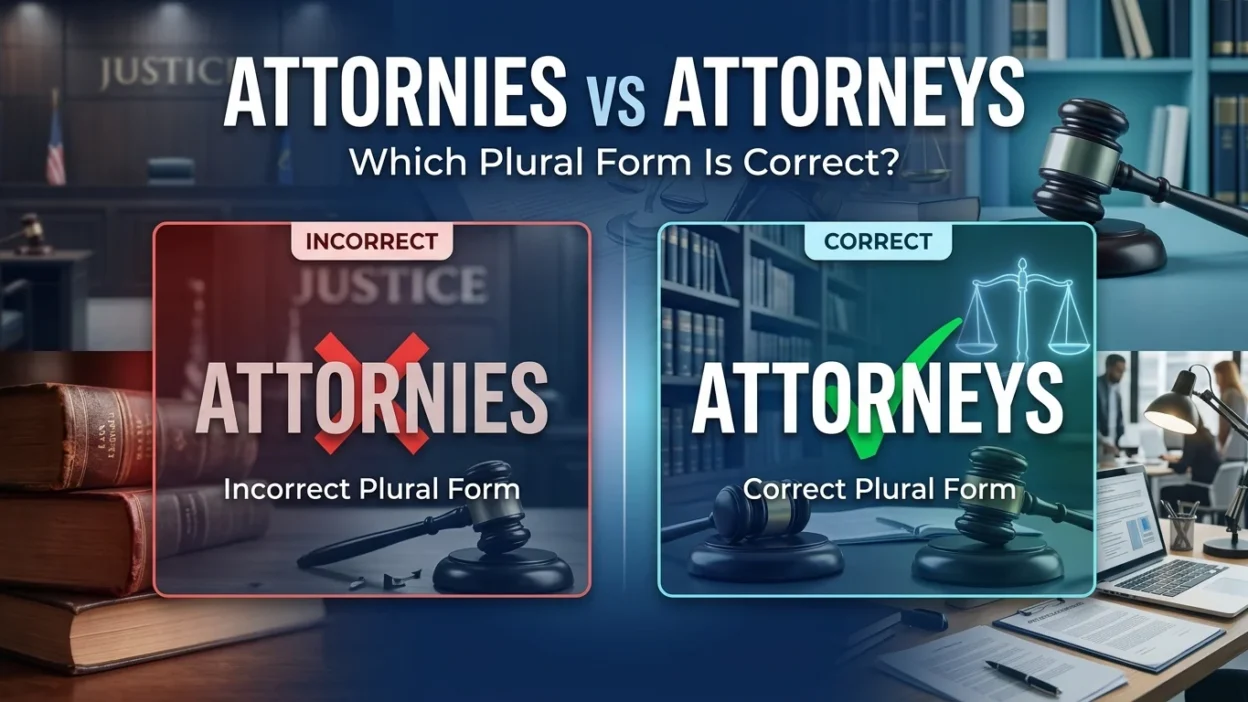
The correct plural form is “attorneys.” “Attornies” is a common misspelling and is not accepted in standard English. Understanding the rule behind this word can help you avoid errors in legal, academic, and professional writing.
Quick Answer
“Attorneys” is the correct spelling.
“Attornies” is incorrect in standard English.
Correct Example
- The attorneys reviewed the contract.
Incorrect Example
- The attornies reviewed the contract.
What Does Attorney Mean?
An attorney is a person who is legally qualified to represent clients, provide legal advice, and practice law.
Common types include:
- corporate attorneys
- criminal defense attorneys
- family law attorneys
- tax attorneys
- intellectual property attorneys
Examples of Attorneys in Sentences
- The attorneys met to discuss the case.
- Several attorneys represented the company.
- The law firm hired new attorneys this year.
- Experienced attorneys reviewed the agreement.
- The attorneys presented their arguments in court.
Why Is the Plural “Attorneys”?
The word attorney ends with a vowel (e) followed by y.
For nouns ending in a vowel + y, simply add s to form the plural.
Examples
| Singular | Plural |
|---|---|
| attorney | attorneys |
| journey | journeys |
| key | keys |
| valley | valleys |
| monkey | monkeys |
Because attorney ends in ey, the correct plural is:
- attorneys
Not:
- attornies
Is Attornies a Real Word?
No, “attornies” is not the accepted plural form in standard English.
Most dictionaries recognize:
- attorney
- attorneys
Not:
- attornies
Attornies vs Attorneys Comparison Table
| Feature | Attorneys | Attornies |
|---|---|---|
| Correct plural form | Yes | No |
| Standard English | Yes | No |
| Dictionary approved | Yes | No |
| Legal writing | Yes | No |
| Professional usage | Yes | No |
Pluralization Rule
Common Mistakes With Attorneys
Applying the Wrong Plural Rule
Many people assume:
- attorney → attornies
because words like:
- city → cities
- baby → babies
follow that pattern.
However, attorney ends in a vowel plus y, so the rule is different.
Confusing Similar Words
Compare:
| Singular | Correct Plural |
|---|---|
| baby | babies |
| city | cities |
| attorney | attorneys |
| key | keys |
| journey | journeys |
Different Uses of Attorneys
Law Firms
Example:
- The attorneys prepared the legal documents.
Court Proceedings
Example:
- Both attorneys presented evidence.
Business Law
Example:
- Corporate attorneys advised the company.
Real Estate
Example:
- The attorneys finalized the property transfer.
Common Phrases Using Attorneys
Defense Attorneys
Meaning: lawyers who represent defendants.
Example:
- Defense attorneys questioned the witnesses.
Corporate Attorneys
Meaning: lawyers specializing in business law.
Example:
- Corporate attorneys reviewed the merger agreement.
Trial Attorneys
Meaning: lawyers who represent clients in court.
Example:
- Trial attorneys prepared for the hearing.
Attorneys at Law
Meaning: licensed legal practitioners.
Example:
- The firm employs experienced attorneys at law.
Synonyms for Attorney
Depending on context, similar words include:
- lawyer
- legal counsel
- advocate
- solicitor
- counselor
Example
- The attorneys and legal counsel reviewed the case.
Opposites of Attorney
There is no direct antonym, but contrasting terms may include:
- client
- defendant
- plaintiff
- litigant
Example
- The attorneys advised their clients throughout the process.
American vs British English Differences
American English
The term attorney is very common.
British English
The terms solicitor and barrister are more common, though attorney is still understood in legal contexts.
The plural remains:
- attorneys
Not:
- attornies
Why Correct Spelling Matters
Using the correct spelling improves:
- professionalism
- legal accuracy
- readability
- credibility
- communication clarity
Misspelling attorneys as attornies can:
- appear unprofessional
- distract readers
- weaken trust in formal documents
Tips to Remember the Correct Spelling
Look at the Ending
Attorney ends with:
- ey
Words ending in vowel + y usually add s.
Think of Similar Words
Examples:
- key → keys
- journey → journeys
- attorney → attorneys
Use the Simple Rule
If a vowel comes before y, just add s.
FAQs
Which spelling is correct: attornies or attorneys?
Attorneys is the correct plural form.
Is attornies a real word?
No. It is considered a misspelling.
Why is the plural attorneys instead of attornies?
Because attorney ends in a vowel plus y, so you simply add s.
What does attorney mean?
An attorney is a legal professional qualified to practice law.
Is attorneys used in legal writing?
Yes. It is the standard plural form in legal and professional writing.
What is the singular form?
The singular form is:
- attorney
Is there a British and American English difference?
The legal professions differ, but the plural spelling remains attorneys.
How can I remember the correct spelling?
Think:
- key → keys
- journey → journeys
- attorney → attorneys
Final Summary
The difference between attornies vs attorneys is straightforward. “Attorneys” is the correct plural form of attorney, while “attornies” is a common spelling mistake. Because attorney ends in a vowel followed by y, you simply add s to form the plural.
Whether you’re writing legal documents, business reports, academic papers, or everyday content, attorneys is the spelling you should always use.
Actionable Takeaway
When referring to more than one attorney, write:
- attorneys ✅
Never write:
- attornies ❌
A simple memory trick:
- Attorney ends in vowel + y, so just add “s.”
Remembering this rule will help you spell attorneys correctly every time.