If you’ve ever wondered whether “layed off” or “laid off” is the correct phrase, you’re not alone. Since many English verbs form the past tense by adding -ed, it’s easy to assume that layed off is correct. However, lay is an irregular verb.
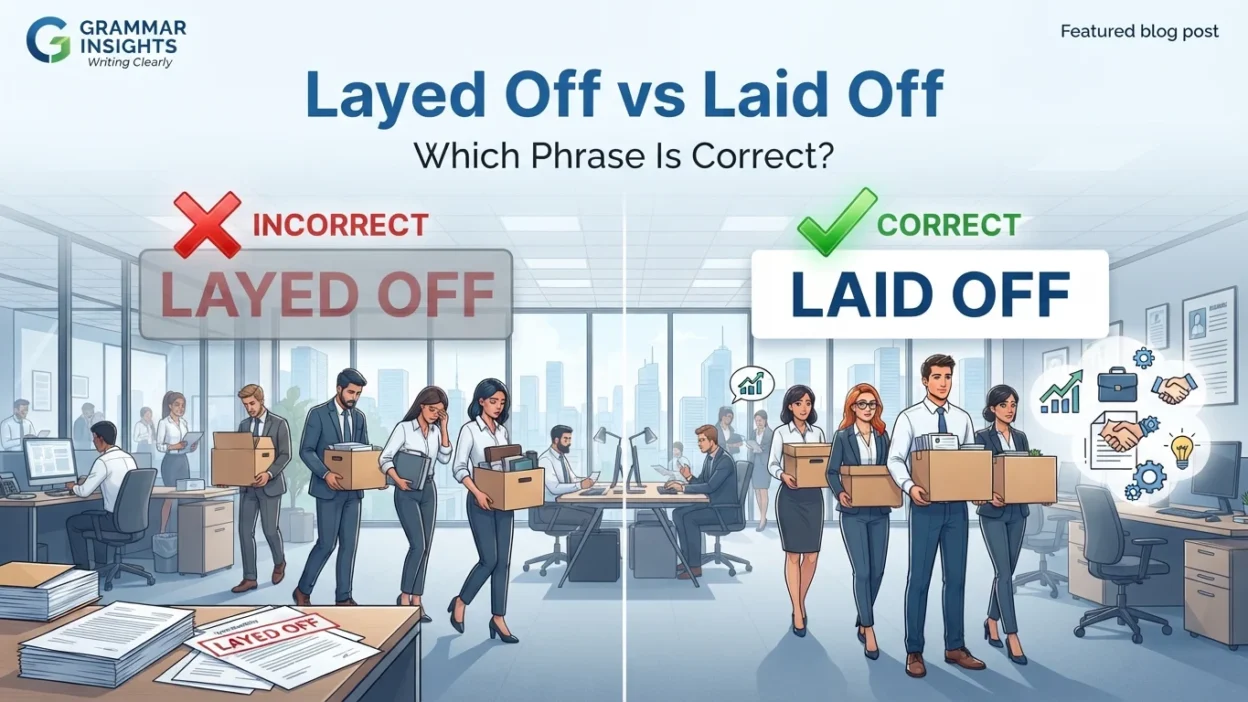
The correct phrase is “laid off.” “Layed off” is a spelling mistake and is not accepted in standard English. If you’re referring to job loss, temporary work suspension, or reducing employees, laid off is always the correct form.
Quick Answer
“Laid off” is the correct spelling.
“Layed off” is incorrect in standard English.
Correct Example
- The company laid off 200 employees.
Incorrect Example
- The company layed off 200 employees.
What Does “Laid Off” Mean?
Laid off is the past tense of the phrasal verb lay off.
It commonly means:
- to terminate an employee’s job because of business reasons
- to temporarily suspend workers
- to stop doing or using something (informally)
The most common meaning relates to employment.
Examples of Laid Off in Sentences
- The company laid off several workers during the recession.
- Hundreds of employees were laid off last year.
- She was laid off after the factory closed.
- Many businesses laid off staff during the economic downturn.
- He was laid off but found another job quickly.
Is Layed Off a Real Phrase?
No, “layed off” is not a correct phrase in standard English.
The verb lay is irregular.
Standard English uses:
- lay
- laid
- laid
Not:
- layed
Why Is It “Laid Off”?
The phrasal verb follows the same irregular verb pattern:
Just as:
- pay → paid
- say → said
the verb lay becomes laid.
Layed Off vs Laid Off Comparison Table
| Feature | Laid Off | Layed Off |
|---|---|---|
| Correct spelling | Yes | No |
| Standard English | Yes | No |
| Dictionary approved | Yes | No |
| Employment writing | Yes | No |
| Professional writing | Yes | No |
Common Mistakes With Laid Off
Adding “-ed” to Lay
Incorrect:
- The company layed off fifty employees.
Correct:
- The company laid off fifty employees.
Confusing Lay and Lie
Remember:
- Lay → Laid
- Lie → Lay (past tense)
These are different verbs with different conjugations.
Assuming Regular Verb Rules
Lay is irregular, so it does not become layed.
Different Uses of Laid Off
Employment
Example:
- She was laid off because of budget cuts.
Temporary Workforce Reduction
Example:
- The factory laid off workers until production resumed.
Informal Meaning (“Stop Doing Something”)
Example:
- You should lay off the junk food.
Past tense:
- He laid off sugary drinks for a month.
Common Phrases Using Laid Off
Laid Off Employees
Meaning: workers whose employment has ended due to business reasons.
Example:
- The laid off employees received severance pay.
Get Laid Off
Meaning: lose a job because of company decisions.
Example:
- He got laid off during the restructuring.
Mass Layoffs
Meaning: large-scale job cuts.
Example:
- The company announced mass layoffs.
Recently Laid Off
Meaning: someone who has just lost a job.
Example:
- She was recently laid off from her position.
Synonyms for Laid Off
Depending on context, similar expressions include:
- dismissed
- terminated
- let go
- furloughed (temporary)
- made redundant (common in British English)
Example
- Hundreds of employees were laid off, or made redundant, after the merger.
Opposites of Laid Off
Antonyms may include:
- hired
- employed
- recruited
- retained
- reinstated
Example
- The company hired new workers after expanding.
American vs British English Differences
American English
The phrase laid off is commonly used.
British English
While laid off is understood, made redundant is more common in employment contexts.
Regardless of variety, the spelling is:
- laid off
Never:
- layed off
Why Correct Spelling Matters
Using the correct spelling improves:
- professionalism
- clarity
- credibility
- job application writing
- business communication
Misspelling laid off as layed off may:
- distract readers
- appear careless
- reduce confidence in your writing
Tips to Remember the Correct Spelling
Learn the Irregular Verb
Think:
- pay → paid
- say → said
- lay → laid
Remember the Phrasal Verb
The phrase always follows the same pattern:
- lay off → laid off
Practice Full Sentences
Example:
- Several employees were laid off last month.
FAQs
Which spelling is correct: layed off or laid off?
Laid off is the correct spelling.
Is layed off a real phrase?
No. It is a spelling mistake.
What does laid off mean?
It usually means losing a job because of business or economic reasons rather than personal performance.
Why isn’t it spelled layed off?
Because lay is an irregular verb whose past tense is laid.
Is laid off used in both British and American English?
Yes, although British English often uses made redundant in employment contexts.
What is the present tense?
The present tense is:
- lay off
Example:
- Companies sometimes lay off workers during slow periods.
What is the past participle?
The past participle is:
- laid off
Example:
- Hundreds of workers have been laid off.
How can I remember the correct spelling?
Think:
- Pay → Paid
- Lay → Laid
Final Summary
The difference between layed off vs laid off is simple. “Laid off” is the correct phrase because laid is the past tense of the irregular verb lay. “Layed off” is a common misspelling and should never be used in standard English.
Whether you’re writing about employment, workforce reductions, or business news, laid off is always the correct choice.
Actionable Takeaway
Whenever you’re referring to someone losing a job or being dismissed for business reasons, write:
- laid off ✅
Never write:
- layed off ❌
A simple memory trick:
- Lay → Laid
- Therefore: Lay off → Laid off
Remembering this irregular verb pattern will help you avoid this common spelling mistake.