If you’ve ever wondered whether “superseded” or “superceded” is the correct spelling, you’re not alone. This is one of the most commonly misspelled words in English because many people expect it to follow the spelling pattern of words like precede and proceed.
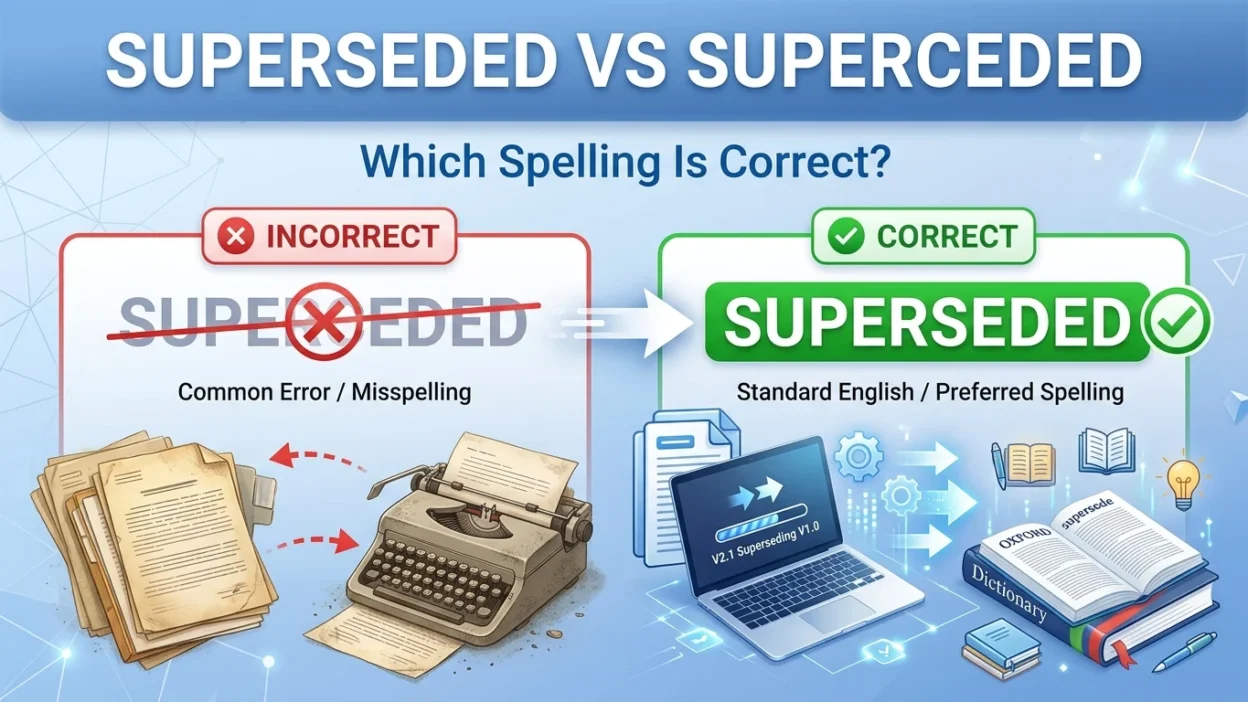
However, the correct spelling is “superseded.” “Superceded” is a common misspelling and is not accepted in standard English. Understanding the correct form can help you avoid mistakes in professional, academic, and everyday writing.
Quick Answer
“Superseded” is the correct spelling.
“Superceded” is incorrect in standard English.
Correct Example
- The old software was superseded by a newer version.
Incorrect Example
- The old software was superceded by a newer version.
What Does Superseded Mean?
Superseded is the past tense and past participle of supersede.
It means:
- replaced by something newer or better
- made obsolete
- displaced by a more recent version
- taken the place of something else
It is commonly used in technology, business, law, publishing, and government.
Examples of Superseded in Sentences
- The outdated policy was superseded by new regulations.
- This model has been superseded by a newer release.
- The original agreement was superseded by a revised contract.
- Printed maps have largely been superseded by GPS navigation.
- The old system was superseded after the upgrade.
Is Superceded a Real Word?
No, “superceded” is not a standard English word.
It is a common spelling mistake caused by confusion with words such as:
- precede
- proceed
- concede
Standard dictionaries recognize:
- superseded
Not:
- superceded
Why Is It Spelled Superseded?
The verb is:
- supersede
Its past tense is formed by adding -d:
- supersede → superseded
Although many English words contain -cede, supersede is an exception. Its spelling comes from its historical development and has remained unchanged.
Superseded vs Superceded Comparison Table
| Feature | Superseded | Superceded |
|---|---|---|
| Correct spelling | Yes | No |
| Standard English word | Yes | No |
| Dictionary approved | Yes | No |
| Professional writing | Yes | No |
| Grammar accepted | Yes | No |
Correct Word Formation
Common Mistakes With Superseded
Replacing “-sede” With “-cede”
Incorrect:
- The law was superceded.
Correct:
- The law was superseded.
Assuming It Follows Similar Words
Words like precede and concede end in -cede, but supersede is an exception.
Typing Too Quickly
The unusual spelling often leads to accidental errors.
Different Uses of Superseded
Technology
Example:
- The previous operating system was superseded by a newer version.
Business
Example:
- The revised policy superseded the original document.
Law
Example:
- The amendment superseded the earlier legislation.
Publishing
Example:
- The first edition was superseded by an updated edition.
Common Phrases Using Superseded
Superseded by
Meaning: replaced by something newer or better.
Example:
- The product was superseded by an improved model.
Superseded Version
Meaning: an older version that has been replaced.
Example:
- Do not use the superseded version of the manual.
Superseded Regulation
Meaning: a rule that is no longer in effect.
Example:
- The superseded regulation has been removed.
Superseded Technology
Meaning: outdated technology replaced by modern alternatives.
Example:
- DVDs have been largely superseded by streaming services.
Synonyms for Superseded
Depending on context, similar words include:
- replaced
- displaced
- overtaken
- outdated
- substituted
Example
- The outdated system was replaced and superseded by modern software.
Opposites of Superseded
Antonyms may include:
- retained
- preserved
- continued
- maintained
- upheld
Example
- The original agreement was maintained rather than superseded.
American vs British English Differences
There is no spelling difference between American and British English.
Both use:
- superseded
Neither uses:
- superceded
Why Correct Spelling Matters
Using the correct spelling improves:
- professionalism
- readability
- credibility
- communication clarity
- writing quality
Misspelling superseded as superceded can:
- distract readers
- appear careless
- reduce confidence in your writing
Tips to Remember the Correct Spelling
Remember the Base Word
The verb is:
- supersede
So the past tense is:
- superseded
Learn the Exception
Although many words end in -cede, supersede ends in -sede.
Practice Full Sentences
Example:
- The new process superseded the old one.
FAQs
Which spelling is correct: superseded or superceded?
Superseded is the correct spelling.
Is superceded a real word?
No. It is considered a spelling mistake.
What does superseded mean?
It means replaced by something newer, better, or more effective.
Why is supersede spelled with -sede instead of -cede?
It is a historical exception in English and has retained the -sede spelling.
Is superseded used in legal and business writing?
Yes. It is commonly used in contracts, policies, regulations, and official documents.
Is there a British and American English difference?
No. Both use superseded.
What is the opposite of superseded?
Depending on context, words such as retained, maintained, or preserved may be opposites.
How can I remember the correct spelling?
Think:
- supersede → superseded
The word always keeps -sede.
Final Summary
The difference between superseded vs superceded is simple. “Superseded” is the correct spelling and refers to something that has been replaced or made obsolete by a newer or better version. “Superceded” is a common misspelling and should be avoided in all forms of writing.
Whether you’re discussing technology, legal documents, business policies, or updated procedures, superseded is the spelling you should always use.
Actionable Takeaway
Whenever you mean replaced or made obsolete, write:
- superseded ✅
Never write:
- superceded ❌
A simple memory trick:
- Supersede is the exception—it ends with “-sede,” not “-cede.”
Remembering this exception will help you spell superseded correctly every time.