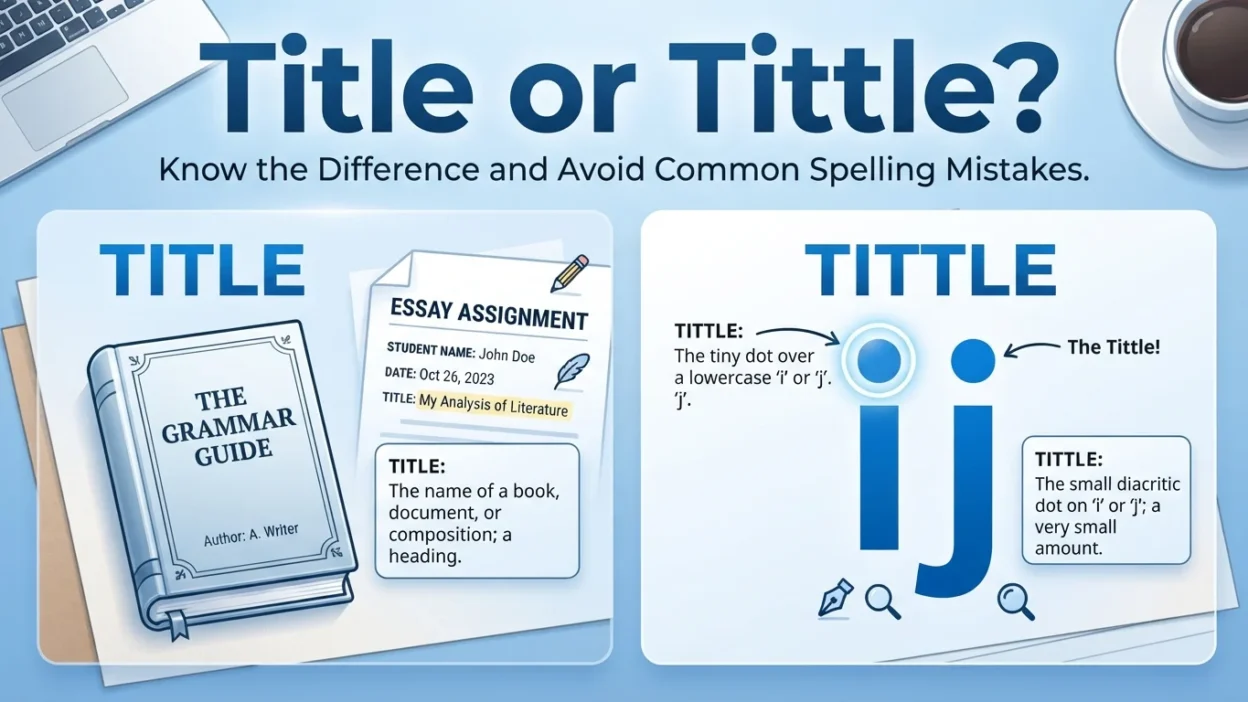
If you’ve ever wondered if “title” or “tittle” is the correct word, you’re not alone. Although these words look similar, they have very different meanings.
Title is a common English word that refers to the name of a book, article, movie, job, or position. Tittle is a rare word that means a very small mark or tiny point, such as the dot above the letters i and j.
Understanding the difference between title or tittle will help you choose the correct word in both writing and conversation.
Quick Answer
- Title = The name of a book, article, movie, job, or position. ✅
- Tittle = A tiny mark or dot, especially the dot over i or j. ✅ (Rarely used)
Correct Examples
- The title of the book is The Great Adventure.
- Don’t forget the tittle above the letter i.
What Does “Title” Mean?
Title is a noun.
It commonly refers to:
- the name of a book, article, song, or film
- a person’s rank or position
- legal ownership of property
Examples of Title in Sentences
- What is the title of your essay?
- She earned the title of team captain.
- The movie’s title attracted a lot of attention.
- He holds the title of professor.
- The house title was transferred to the new owner.
What Does “Tittle” Mean?
Tittle is a noun, but it is rarely used in everyday English.
It means:
- a tiny mark or point
- the dot above the letters i and j
- a very small detail
The word also appears in the biblical expression “jot and tittle,” meaning the smallest detail.
Examples of Tittle in Sentences
- The tittle is the dot above the letter i.
- Every jot and tittle of the contract was carefully reviewed.
- The calligrapher paid attention to every tittle.
Title vs Tittle Comparison Table
| Feature | Title | Tittle |
|---|---|---|
| Common everyday word | ✅ Yes | ❌ No |
| Means the name of something | ✅ Yes | ❌ No |
| Means a tiny mark or dot | ❌ No | ✅ Yes |
| Used in books, films, and jobs | ✅ Yes | ❌ No |
| Standard English | ✅ Yes | ✅ Yes (rare) |
Word Comparison
When to Use Title
Use title when referring to:
- books
- articles
- movies
- songs
- job positions
- honours and ranks
Examples
- The title of the article is misleading.
- She won the world championship title.
- Please include a title at the top of your report.
- His official title is Managing Director.
When to Use Tittle
Use tittle when referring to:
- the dot above i or j
- a very tiny mark
- a very small detail (usually in literary or biblical contexts)
Examples
- The teacher reminded students not to forget the tittle on the lowercase i.
- The editor checked every jot and tittle before publication.
- Good handwriting includes clear tittles.
Common Mistakes
Using Tittle Instead of Title
Incorrect:
- What is the tittle of your book?
Correct:
- What is the title of your book?
Misspelling Title
Many people accidentally type tittle when they mean title because the words look similar.
Common Phrases
Title
- book title
- job title
- title page
- title deed
- title holder
Tittle
- jot and tittle
- dot (tittle) over the i
- every jot and tittle
Synonyms
Synonyms for Title
- name
- heading
- caption
- designation
- rank
Synonyms for Tittle
- dot
- mark
- point
- tiny detail
American vs British English Differences
There is no difference between American and British English.
Both varieties use:
- title for names, positions, and ownership.
- tittle for the tiny dot above i or j, although it is rarely used outside specialist or literary contexts.
Why Correct Word Choice Matters
Using the correct word helps you:
- improve spelling accuracy
- avoid embarrassing typos
- communicate clearly
- write professionally
Since title is one of the most frequently used English words, confusing it with tittle can make your writing appear less polished.
Tips to Remember the Difference
Title = Name
Think of title whenever you’re referring to the name of something.
Example:
- The title of the novel is Pride and Prejudice.
Tittle = Tiny Dot
Think of tittle as the tiny dot above i or j.
Example:
- Every lowercase i has a tittle.
Easy Memory Trick
- Title = Name
- Tittle = Tiny Dot
Frequently Asked Questions (FAQs)
What is the difference between title and tittle?
Title refers to the name of a book, article, job, or position, while tittle refers to the tiny dot above the letters i and j or a very small detail.
Which is correct: “book title” or “book tittle”?
The correct phrase is book title.
Is tittle a real word?
Yes. Tittle is a real English word, but it is uncommon and usually refers to the dot above i and j or appears in the phrase “jot and tittle.”
Why do people confuse title and tittle?
Because the words are spelled similarly, tittle is a common typo for title.
What does “jot and tittle” mean?
It means every small detail, with nothing omitted.
Is there a difference between British and American English?
No. Both varieties use title and tittle with the same meanings.
How can I remember the difference?
Think:
- Title = Name
- Tittle = Tiny dot
Final Summary
The difference between title or tittle is easy to remember. Title is the correct word when referring to the name of a book, article, film, job, or position. Tittle is a rare word meaning the tiny dot above the letters i and j or a very small detail.
In almost all everyday writing, you’ll need title, not tittle.
Actionable Takeaway
Use:
- title ✅ for names, headings, positions, and ownership.
- tittle ✅ only when referring to the tiny dot above i or j, or in the phrase “jot and tittle.”
Memory trick:
- Title = Name
- Tittle = Tiny dot