
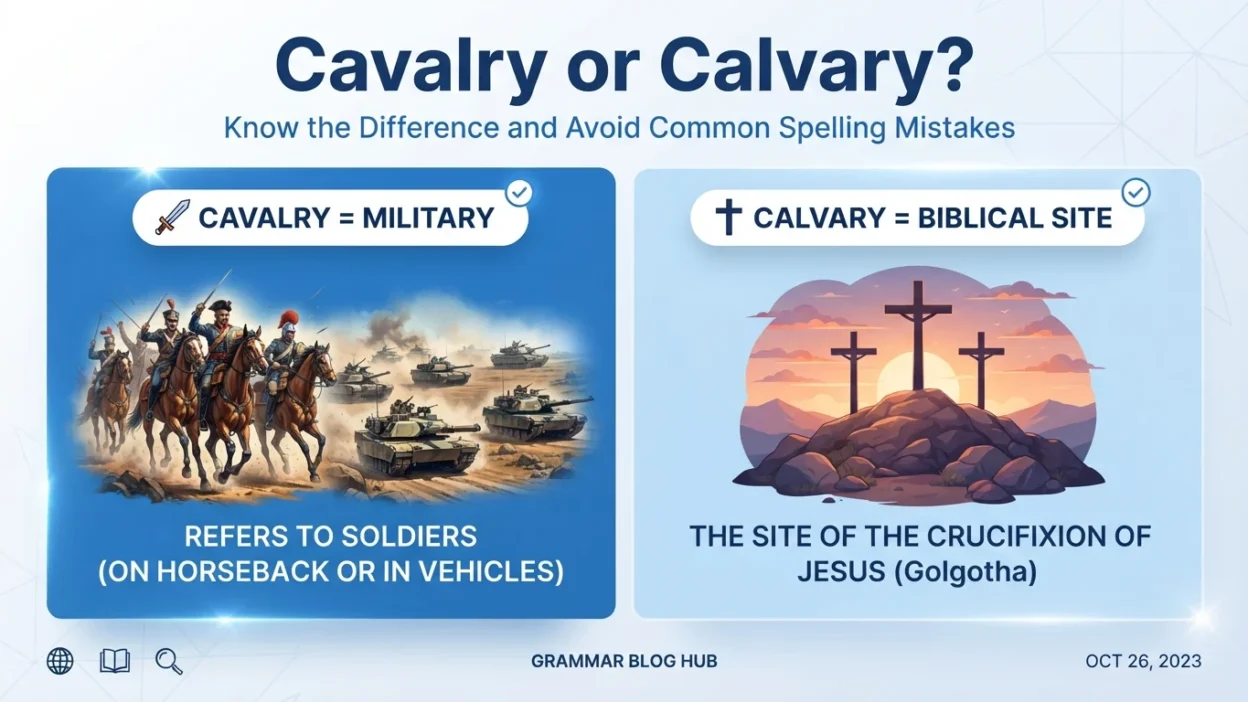
If you’ve ever wondered if “cavalry” or “Calvary” is the correct word, you’re not alone. These words are often confused because they sound similar, but they have very different meanings.
Cavalry refers to soldiers who fight on horseback or, in modern times, armoured military units. Calvary is a biblical place where Jesus Christ was crucified. Understanding the difference between cavalry or Calvary will help you avoid a common spelling mistake.
Quick Answer
- Cavalry = Mounted soldiers or modern armoured military units. ✅
- Calvary = The hill where Jesus Christ was crucified. ✅
Correct Examples
- The cavalry charged across the battlefield.
- Christians believe Jesus was crucified at Calvary.
What Does “Cavalry” Mean?
Cavalry is a noun.
It refers to:
- soldiers who fought on horseback
- military units equipped with tanks or armoured vehicles in modern armies
- figuratively, help arriving at the right moment
Examples of Cavalry in Sentences
- The cavalry arrived just before sunset.
- The king sent his cavalry into battle.
- Modern cavalry often operates armoured vehicles.
- Don’t worry the cavalry is on its way! (figurative)
- The cavalry protected the army’s flank.
What Does “Calvary” Mean?
Calvary is a proper noun.
It refers to:
- the hill outside Jerusalem where Jesus Christ was crucified
- a symbol of Christ’s suffering and sacrifice in Christianity
The name comes from the Latin word Calvaria, meaning “skull.”
Examples of Calvary in Sentences
- According to the Bible, Jesus was crucified at Calvary.
- The church displayed a painting of Calvary.
- Pilgrims visited Calvary during their journey.
- The sermon reflected on the events at Calvary.
- Calvary is central to the Christian story of redemption.
Cavalry vs Calvary Comparison Table
| Feature | Cavalry | Calvary |
|---|---|---|
| Refers to soldiers | ✅ Yes | ❌ No |
| Refers to a biblical location | ❌ No | ✅ Yes |
| Military term | ✅ Yes | ❌ No |
| Religious term | ❌ No | ✅ Yes |
| Standard English | ✅ Yes | ✅ Yes |
Word Comparison
When to Use Cavalry
Use cavalry when referring to:
- horse mounted soldiers
- armoured military units
- rescue or help arriving
Examples
- The cavalry crossed the river at dawn.
- Heavy cavalry led the attack.
- The police cavalry patrolled the parade route.
- We called for backup, and the cavalry arrived.
When to Use Calvary
Use Calvary when referring to:
- the site of Jesus’ crucifixion
- Christian teachings about the crucifixion
- religious symbolism related to Christ’s sacrifice
Examples
- The hymn speaks of Calvary.
- Many Christians pray while reflecting on Calvary.
- Artists have depicted Calvary for centuries.
- The pastor preached about the meaning of Calvary.
Common Mistakes
Using Calvary Instead of Cavalry
Incorrect:
- The Calvary rescued the soldiers.
Correct:
- The cavalry rescued the soldiers.
Using Cavalry Instead of Calvary
Incorrect:
- Jesus was crucified at cavalry.
Correct:
- Jesus was crucified at Calvary.
Common Phrases
Cavalry
- the cavalry arrived
- cavalry charge
- cavalry regiment
- armoured cavalry
- call in the cavalry
Calvary
- Cross of Calvary
- Hill of Calvary
- Road to Calvary
- Calvary Chapel
- Calvary sacrifice
Synonyms
Synonyms for Cavalry
- mounted troops
- horse soldiers
- armoured corps
- mounted regiment
Related Terms for Calvary
- Golgotha
- Place of the Skull
- Crucifixion site
- Holy hill
American vs British English Differences
There is no difference between American and British English.
Both varieties use:
- cavalry for military units.
- Calvary for the biblical location of Jesus’ crucifixion.
Why Correct Word Choice Matters
Using the correct word helps you:
- avoid confusing military and religious terms
- improve spelling accuracy
- communicate clearly
- write professionally
Because cavalry and Calvary sound similar, they are commonly mixed up in writing.
Tips to Remember the Difference
Cavalry = Soldiers
Think of cavalry as containing “caval-“, related to cavalier and horsemen.
Example:
- The cavalry rode into battle.
Calvary = Crucifixion
Think of Calvary as the place connected with Christ’s crucifixion.
Example:
- Jesus died on the cross at Calvary.
Easy Memory Trick
- Cavalry = Combat
- Calvary = Christ
(FAQs)
What is the difference between cavalry and Calvary?
Cavalry refers to mounted soldiers or modern armoured military units, while Calvary is the biblical site where Jesus Christ was crucified.
Which is correct: “the cavalry arrived” or “the Calvary arrived”?
The correct phrase is the cavalry arrived.
What is Calvary in the Bible?
Calvary is the traditional name for the place where Jesus Christ was crucified. It is also known as Golgotha.
Can cavalry refer to modern armies?
Yes. Today, cavalry often refers to armoured or reconnaissance units rather than soldiers on horseback.
Why are cavalry and Calvary confused?
They are pronounced similarly, making them a common spelling mistake.
Is there a difference between British and American English?
No. Both varieties use cavalry and Calvary with the same meanings.
How can I remember the difference?
Think:
- Cavalry = Combat
- Calvary = Christ
Final Summary
The difference between cavalry and Calvary is easy to remember. Cavalry refers to soldiers or military units, while Calvary refers to the biblical hill where Jesus Christ was crucified.
Whenever you’re writing about armies or mounted troops, use cavalry. When referring to the events of the crucifixion or Christian history, use Calvary.
Actionable Takeaway
Use:
- cavalry ✅ for mounted soldiers or modern armoured units.
- Calvary ✅ for the biblical site of Jesus’ crucifixion.
Memory trick:
- Cavalry = Combat
- Calvary = Christ