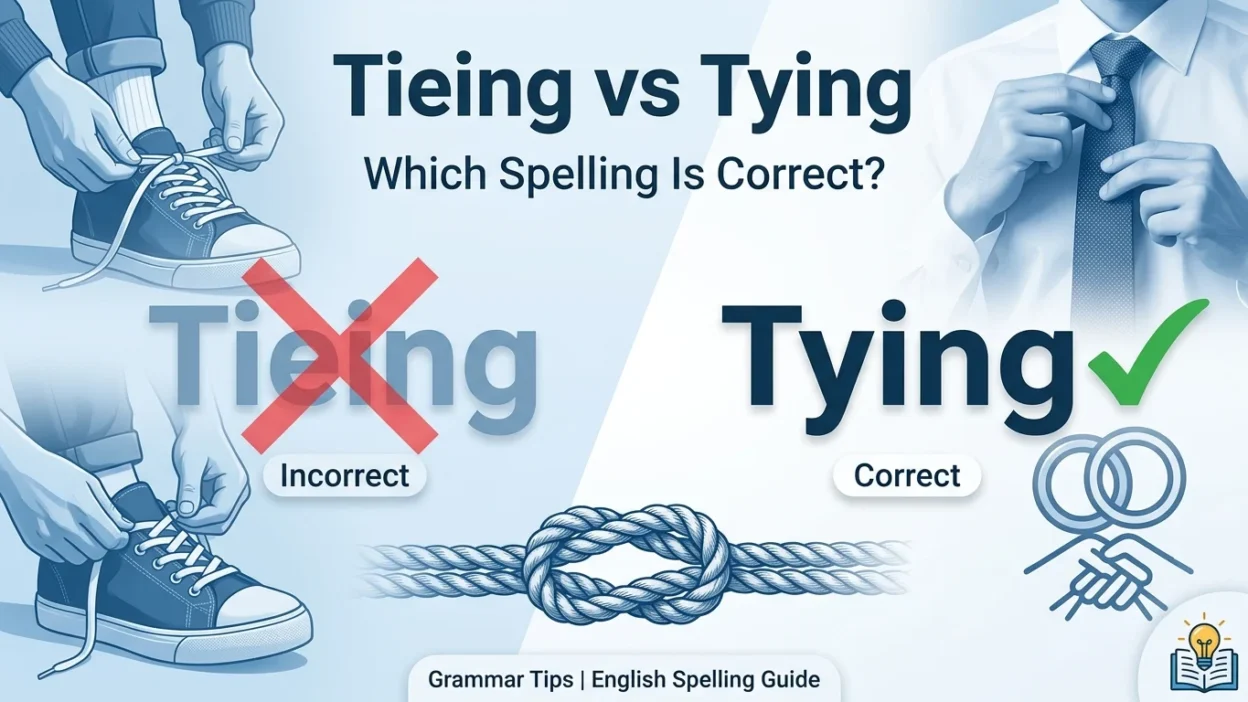
If you’ve ever wondered whether “tieing” or “tying” is the correct spelling, you’re not alone. Since the verb tie ends in -ie, many writers assume that adding -ing should create tieing. However, English follows a special spelling rule for verbs ending in -ie.
The correct spelling is “tying.” “Tieing” is considered a misspelling in modern English and should be avoided in formal, academic, and everyday writing.
Quick Answer
“Tying” is the correct spelling.
“Tieing” is incorrect in standard English.
Correct Example
- She is tying her shoelaces.
Incorrect Example
- She is tieing her shoelaces.
What Does Tying Mean?
Tying is the present participle and gerund form of the verb tie.
It means:
- fastening something with a knot
- attaching one thing to another
- connecting or securing objects
- ending a competition with the same score (a tie)
Examples of Tying in Sentences
- He is tying his necktie.
- She spent the morning tying balloons together.
- They are tying the boat to the dock.
- The teams are tying in the final minutes of the game.
- Tying your shoes properly helps prevent falls.
Is Tieing a Real Word?
No, “tieing” is not accepted in standard modern English.
Standard dictionaries recognize:
- tie
- tying
Not:
- tieing
Why Is It Spelled “Tying”?
When a verb ends in -ie, English usually changes the -ie to -y before adding -ing.
Rule
This prevents awkward letter combinations and makes the word easier to read.
Similar Examples
| Base Verb | Correct -ing Form |
|---|---|
| tie | tying |
| die | dying |
| lie | lying |
| vie | vying |
Notice that -ie changes to -y before adding -ing.
Tieing vs Tying Comparison Table
| Feature | Tying | Tieing |
|---|---|---|
| Correct spelling | Yes | No |
| Standard English | Yes | No |
| Dictionary approved | Yes | No |
| Professional writing | Yes | No |
| Grammar accepted | Yes | No |
Common Mistakes With Tying
Keeping the “ie”
Incorrect:
- She is tieing the ribbon.
Correct:
- She is tying the ribbon.
Forgetting the Special Rule
Many people simply add -ing without changing -ie to -y.
Typing Too Quickly
Fast typing often produces tieing by mistake.
Different Uses of Tying
Clothing
Example:
- He is tying his tie.
Shoes
Example:
- She is tying her shoelaces.
Boats
Example:
- They are tying the boat to the pier.
Sports
Example:
- The teams are tying with only seconds remaining.
Common Phrases Using Tying
Tying the Knot
Meaning: getting married.
Example:
- They’re tying the knot this summer.
Tying Up Loose Ends
Meaning: finishing remaining tasks.
Example:
- I’m tying up loose ends before vacation.
Tying Shoes
Meaning: fastening shoelaces.
Example:
- Children learn tying shoes at an early age.
Tying Together
Meaning: connecting items.
Example:
- She is tying the flowers together.
Synonyms for Tying
Depending on context, similar words include:
- fastening
- securing
- binding
- attaching
- connecting
Example
- He was tying and securing the ropes.
Opposites of Tying
Antonyms may include:
- untying
- loosening
- releasing
- separating
- disconnecting
Example
- She finished untying the knot.
American vs British English Differences
There is no spelling difference.
Both American and British English use:
- tying
Neither uses:
- tieing
Why Correct Spelling Matters
Using the correct spelling improves:
- professionalism
- readability
- credibility
- communication clarity
- writing quality
Misspelling tying as tieing can:
- distract readers
- appear careless
- reduce confidence in your writing
Tips to Remember the Correct Spelling
Learn the “-ie” Rule
If a verb ends in -ie, change it to -y before adding -ing.
Examples:
- die → dying
- lie → lying
- tie → tying
Practice Similar Words
Remember these together:
- dying
- lying
- tying
- vying
Practice Full Sentences
Example:
- She is tying the package with string.
FAQs
Which spelling is correct: tieing or tying?
Tying is the correct spelling.
Is tieing a real word?
No. It is considered a misspelling in standard English.
Why is tying spelled without “ie”?
Because verbs ending in -ie change -ie to -y before adding -ing.
What does tying mean?
It means fastening, securing, or connecting something with a knot or similar method.
Is tying used in British and American English?
Yes. Both varieties use tying.
What is the past tense of tie?
The past tense is:
- tied
What are similar spelling examples?
Examples include:
- die → dying
- lie → lying
- tie → tying
How can I remember the correct spelling?
Think of the rule:
- -ie changes to -y before -ing.
Final Summary
The difference between tieing vs tying is simple. “Tying” is the correct spelling and follows the standard English rule that changes -ie to -y before adding -ing. “Tieing” is a common misspelling and should be avoided in all forms of writing.
Whether you’re talking about shoelaces, ropes, wedding ceremonies, or sports scores, tying is always the correct choice.
Actionable Takeaway
Whenever you need the -ing form of tie, write:
- tying ✅
Never write:
- tieing ❌
A simple memory trick:
- Tie → Tying just like Die → Dying and Lie → Lying.
Remembering this spelling rule will help you avoid the mistake every time.